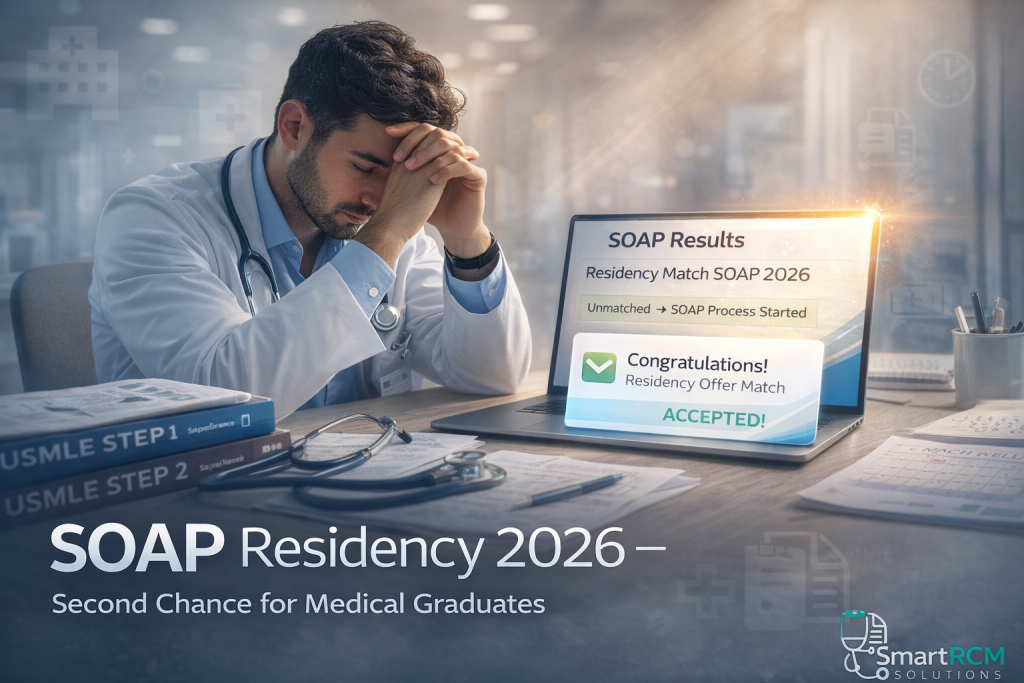
The SOAP Residency 2026 (Supplemental Offer and Acceptance Program) is a critical opportunity for medical graduates who do not match during the Residency Match 2026. Every year, thousands of applicants face the uncertainty of going unmatched; however, SOAP provides a structured and fair system to secure unfilled residency positions during Match Week 2026.
SOAP Residency
Instead of leaving candidates without options, this process allows them to apply to available programs, receive offers, and potentially secure a residency position within days. Therefore, understanding the SOAP process, eligibility criteria, timeline, and strategy becomes essential for applicants who want to maximize their chances after Match Day.
What is SOAP in Residency?
The Supplemental Offer and Acceptance Program (SOAP) is a system managed by the NRMP that allows unmatched applicants to apply for unfilled residency positions.
During this process:
- Applicants apply through ERAS
- Programs review applications quickly
- Offers are sent in multiple rounds
Unlike the regular match, SOAP is fast-paced and requires quick decision-making. As a result, preparation and awareness play a crucial role in success.
Who is Eligible for SOAP 2026?
Not every applicant automatically qualifies for SOAP. However, most unmatched candidates who meet NRMP requirements can participate.
Eligibility Criteria:
- Registered for the NRMP Match
- Eligible to start residency training
- Unmatched or partially matched
International Medical Graduates (IMGs) can also participate, although their chances depend on specialty selection and application strength.
SOAP Residency 2026 Timeline
Understanding the SOAP 2026 timeline is extremely important because everything happens within a few days.
Match Week (Monday)
- Applicants learn if they matched or not
- Unmatched candidates become eligible for SOAP
Unfilled Positions Released
- List of unfilled residency programs becomes available
- Applicants begin selecting programs
Application Submission & Review
- Candidates apply via ERAS
- Programs review applications and shortlist candidates
Offer Rounds Begin
- Programs send offers in multiple rounds
- Applicants must accept or reject quickly
Match Confirmation
- Accepted offer = secured residency position
How SOAP Works (Step-by-Step Process)
The SOAP process follows a structured workflow that ensures fairness and transparency.
1. Access Unfilled Programs List
Applicants receive a list of programs with available positions. These are often in specialties like:
- Internal Medicine
- Family Medicine
- Pediatrics
2. Submit Applications via ERAS
Applicants can apply to multiple programs. However, choosing the right programs increases success chances.
3. Program Review & Shortlisting
Programs review applications quickly and select candidates for potential offers.
4. Interview or Communication
Some programs conduct brief interviews or phone calls.
5. Offer Rounds
Programs send offers in rounds. Applicants must respond within a limited time.
6. Acceptance
Once accepted, the candidate is officially placed into a residency program.
Specialties Available in SOAP
Not all specialties participate equally in SOAP. Therefore, understanding availability is crucial.
Common SOAP Specialties:
- Internal Medicine
- Family Medicine
- Pediatrics
- Pathology
Less Common / Rare:
- Surgery
- Radiology
- Dermatology
- Orthopedics
Highly competitive specialties rarely have unfilled positions. Consequently, flexibility significantly improves success chances.
IMG Strategy for SOAP 2026
International Medical Graduates must approach SOAP strategically.
Key Tips:
- Apply to IMG-friendly specialties
- Focus on programs with a history of IMG intake
- Highlight clinical experience and USMLE scores
Moreover, reviewing IMG match rate by specialty helps applicants prioritize realistic options.
SOAP vs Regular Match – Key Differences
| Feature | Regular Match | SOAP |
|---|---|---|
| Timing | Months-long process | Few days |
| Application Speed | Normal | Very fast |
| Competition | Structured | Highly intense |
| Decision Time | Flexible | Very limited |
SOAP requires quick decisions, whereas the regular match allows more time for planning.
Common Mistakes to Avoid in SOAP
Avoiding mistakes can significantly improve your chances.
❌ Common Errors:
- Applying late
- Ignoring backup specialties
- Poor personal statement
- Missing deadlines
- Rejecting offers without strategy
✅ Best Practices:
- Prepare documents in advance
- Apply early and broadly
- Stay flexible with specialties
- Respond quickly to offers
SOAP Strategy – How to Maximize Your Chances
A strong strategy can make a major difference.
1. Be Flexible
Choosing only competitive specialties reduces chances.
2. Apply Smartly
Target programs that align with your profile.
3. Prepare Documents Early
Ensure your CV, personal statement, and LORs are ready.
4. Act Fast
Timing is everything in SOAP.
5. Accept Realistic Offers
Securing a position is better than waiting another year.
What Happens If You Still Don’t Match?
If a candidate does not secure a position through SOAP, several options remain:
- Reapply next year
- Gain clinical experience
- Improve USMLE scores
- Consider research positions
Although it can be disappointing, many applicants successfully match in the following cycle with better preparation.
Real-Life SOAP Examples
Example 1 – IMG who matched in Internal Medicine
A non-US IMG from Pakistan applied for Internal Medicine but did not match in the main cycle due to low US clinical exposure.
👉 During SOAP:
- He applied to 35 Internal Medicine programs
- Focused on community hospitals that accept IMGs
- Highlighted USCE and strong Step 2 CK score
✔ Result:
He received 2 SOAP offers and successfully matched into a community Internal Medicine residency in New York.
💡 Lesson:
Targeting IMG-friendly programs in SOAP increases success chances significantly.
Example 2 – US Graduate switching to Family Medicine
A US medical graduate initially applied for Surgery but did not match due to high competition.
👉 During SOAP:
- He quickly switched to Family Medicine
- Applied broadly across 40 programs
- Accepted interview calls within 24 hours
✔ Result:
Matched into a Family Medicine program in Texas through SOAP Round 2.
💡 Lesson:
Flexibility in specialty choice during SOAP is critical.
Example 3 – IMG who failed SOAP but improved next cycle
An IMG from India did not match in both main cycle and SOAP due to limited US clinical experience.
👉 After SOAP failure:
- He worked as a clinical observer in the US
- Improved USMLE Step 3 score
- Strengthened CV with research
✔ Result (Next Year):
Successfully matched in Internal Medicine residency 2027 cycle.
💡 Lesson:
SOAP is not the end—it’s feedback for improvement.
FAQs
Q1: What is SOAP in residency?
SOAP is a program that allows unmatched applicants to apply for unfilled residency positions during Match Week.
Q2: When does SOAP 2026 start?
SOAP begins during Match Week 2026, immediately after unmatched applicants are identified.
Q3: Can IMGs participate in SOAP?
Yes, IMGs can participate if they meet eligibility criteria.
Q4: How many programs can I apply to in SOAP?
Applicants can apply to multiple programs, but strategic selection is recommended.
Q5: Are all specialties available in SOAP?
No, most positions are in primary care specialties like Internal Medicine and Pediatrics.
Conclusion
The SOAP Residency 2026 offers a valuable second chance for unmatched applicants to secure a residency position. By understanding the process, timeline, and strategies, candidates can significantly improve their chances of success.
Moreover, preparing in advance, staying flexible, and acting quickly during offer rounds are key factors that determine outcomes. While SOAP can be intense, it remains an effective pathway to continue a medical career without delay.
Real-life examples show that success in SOAP depends on quick decision-making, strategic specialty choice, and readiness before Match Week. Even if SOAP does not work out, it can still serve as a learning phase for the next application cycle.
Ultimately, SOAP ensures that no prepared candidate is completely left without options in the Residency Match 2026 process.