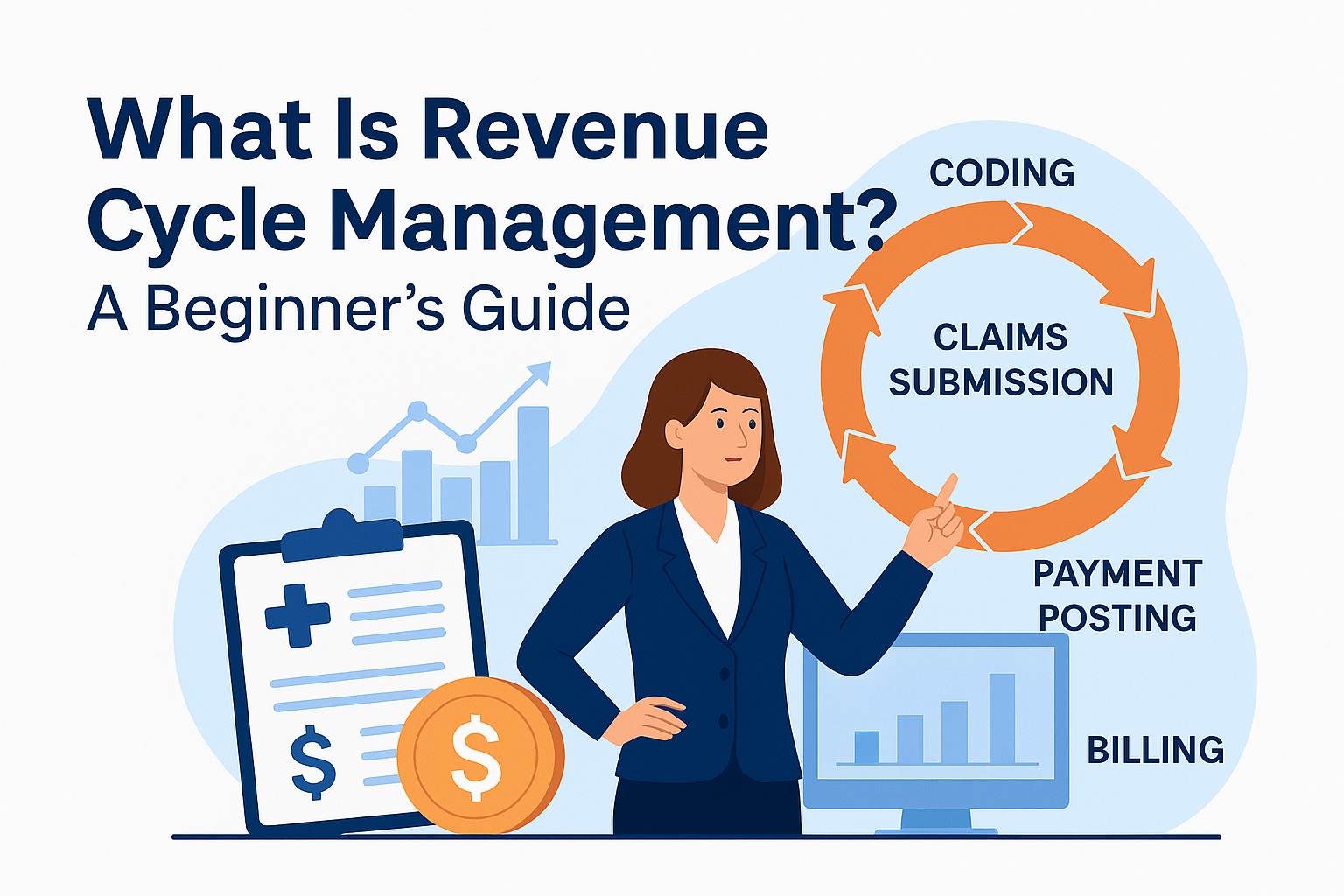
Revenue Cycle Management (RCM) plays a critical role in the financial success of any healthcare practice. However, many clinics struggle with delayed payments, claim denials, and billing inefficiencies because the process is not fully optimized.
For example, a simple mistake during patient registration can result in claim rejection weeks later. As a result, providers face cash flow issues and administrative burden. Therefore, understanding how the RCM process works in real-world scenarios is essential for improving revenue and operational efficiency.
In this detailed guide, we will break down each step of Revenue Cycle Management while also sharing practical insights that help healthcare providers reduce errors and speed up reimbursements.

What Is Revenue Cycle Management (RCM)?
Revenue Cycle Management (RCM) is the process used by healthcare systems to manage the financial aspects of patient services. It begins the moment a patient schedules an appointment and ends once all claims and payments have been processed. The goal of RCM is to identify, collect, and manage revenue from payers and patients efficiently.
In simpler terms, RCM is how healthcare providers get paid for the services they deliver.
Real-Life Example of Revenue Cycle Management
To better understand how RCM works, let’s look at a real-world example.
A patient visits a clinic for a consultation. First, the front desk collects accurate insurance and demographic details. Next, the billing team verifies eligibility before the appointment. After the visit, the provider documents the services, and a coder assigns the correct medical codes.
Once the claim is submitted, the insurance company reviews it. If everything is correct, the payment is processed. However, if there is an issue such as incorrect coding, the claim gets denied. In that case, the billing team corrects the error and resubmits the claim.
This entire journey—from appointment scheduling to final payment—is known as the revenue cycle.
Key Steps in the RCM Process
Here we have listed the steps of RCM.

1. Patient Scheduling and Registration
The cycle begins when a patient calls or books an appointment. During registration, accurate demographic and insurance information is collected, including name, date of birth, insurance ID, and policy details. Accurate registration is vital to avoid downstream billing errors.
2. Eligibility and Insurance Verification
This step ensures the patient’s insurance is active and covers the services scheduled. Real-time verification tools help identify coverage gaps, copayments, deductibles, and prior authorization needs before services are rendered.
3. Charge Capture
Charge capture is the process of recording the services provided to the patient. It typically involves using medical codes (CPT, HCPCS) that align with the care given during a visit or procedure.
4. Medical Coding
Medical coders translate provider notes and clinical documentation into standard codes (ICD-10, CPT, etc.). These codes determine how a claim will be processed and reimbursed.
5. Charge Entry
The charges are entered into the medical billing software using the coded data. This includes linking diagnosis codes with appropriate procedure codes and applying any necessary modifiers.
6. Claim Submission
Once coded and reviewed, claims are submitted electronically to insurance companies or government payers like Medicare and Medicaid. Clean claims reduce delays and rejections. You can also explore our BCBS prefix list to verify payer details during claim submission
7. Payment Posting
Payments received from insurance companies and patients are posted against each claim. This step allows healthcare providers to track which payments have been made, denied, or are still outstanding.
8. Denial Management
If a claim is denied, the biller investigates the reason and corrects the issue before resubmitting the claim. Effective denial management helps maintain steady cash flow and avoid write-offs.
9. Patient Collections
After insurance has paid its share, patients are billed for the remaining balance. This step may involve sending statements, setting up payment plans, or following up on overdue accounts.
To understand the full billing workflow, read our medical billing process guide.
Common Revenue Cycle Management Mistakes
Although the RCM process seems straightforward, many healthcare providers face revenue loss due to avoidable mistakes.
Some of the most common issues include:
- Incorrect patient registration details, which lead to claim rejection
- Failure to verify insurance eligibility before services
- Coding errors that result in denied or underpaid claims
- Late claim submission, which delays reimbursement
- Poor follow-up on denied claims
Therefore, addressing these issues early can significantly improve claim acceptance rates and overall revenue performance.
Key RCM Metrics You Should Track
To measure the effectiveness of your revenue cycle, it is important to track key performance indicators (KPIs). These metrics help identify inefficiencies and improve financial outcomes.
Some essential RCM KPIs include:
- Days in Accounts Receivable (AR)
- Claim Denial Rate
- Clean Claim Rate
- First Pass Resolution Rate
- Patient Collection Rate
By regularly monitoring these metrics, healthcare providers can quickly identify issues and take corrective action.
How to Improve Your RCM Process in 2026
Improving your revenue cycle management process requires a proactive approach. While many healthcare providers focus only on claim submission, long-term success depends on optimizing every stage of the cycle.
First, ensure that patient information is collected accurately at the front desk. Even small errors at this stage can lead to claim denials later. Next, use real-time eligibility verification tools to confirm insurance coverage before services are provided.
In addition, regular staff training plays a key role in reducing coding and billing errors. When your team stays updated with payer requirements, the chances of claim rejection decrease significantly.
Moreover, healthcare practices should focus on tracking performance metrics such as denial rates and days in accounts receivable. These insights help identify problem areas and improve decision-making.
Finally, consistent follow-up on unpaid claims ensures that no revenue is lost. By taking a structured and proactive approach, providers can significantly improve cash flow and overall financial performance.
Role of Technology in Revenue Cycle Management
Modern healthcare practices rely heavily on technology to streamline the RCM process. Advanced billing software and integrated systems help reduce manual errors and improve efficiency.
For example, automated eligibility verification tools can prevent claim denials before they happen. Similarly, electronic claim submission speeds up reimbursement and reduces paperwork.
As a result, using the right technology can significantly improve the overall performance of your revenue cycle.
Why Revenue Cycle Management Is Important
An efficient RCM process improves both financial performance and patient satisfaction. Here’s why it matters:
- Reduces claim denials and rework.
- Improves cash flow and revenue predictability.
- Enhances operational efficiency.
- Ensures regulatory and payer compliance.
- Provides accurate financial reporting.
Common Challenges in RCM
Despite its importance, RCM is often affected by challenges such as:
- Inaccurate patient registration.
- Delays in coding or billing.
- Outdated or poorly integrated software.
- High denial rates.
- Lack of staff training or resources.
- Inefficient follow-up on accounts receivable.
Best Practices for Effective RCM
- Use Integrated Software Systems: Choose EHR and billing systems that are seamlessly connected to eliminate data silos.
- Regular Staff Training: Ensure your front office, coders, and billers are up to date on changes in payer policies and compliance rules.
- Automate Where Possible: Automate tasks like eligibility checks, payment reminders, and claims submission to reduce errors.
- Track KPIs Regularly: Monitor performance indicators like days in AR, denial rates, and clean claim rates.
- Focus on Clean Claims: Ensure every claim is reviewed and validated before submission to minimize rejections and rework.
- Patient Transparency: Provide patients with upfront cost estimates and clear billing communication to improve collections and trust.
How Outsourcing Can Help
Many healthcare providers outsource their RCM processes to medical billing companies for better efficiency and compliance. Outsourcing can help:
- Reduce staffing overhead
- Increase revenue through better denial management
- Ensure billing is done accurately and on time
- Allow providers to focus on patient care

Future Trends in Revenue Cycle Management
As healthcare continues to evolve, revenue cycle management is also becoming more advanced and technology-driven. Many providers are now adopting automation and artificial intelligence to reduce manual errors and improve efficiency.
For instance, predictive analytics tools can identify potential claim denials before submission. Similarly, automated billing systems help streamline repetitive tasks, allowing staff to focus on more critical responsibilities.
In addition, patient expectations are changing. More patients now prefer transparent billing and digital payment options. Therefore, healthcare providers must adapt their RCM processes to meet these expectations while maintaining compliance and accuracy.
By staying updated with these trends, providers can build a more resilient and future-ready revenue cycle system.
Conclusion:
Revenue Cycle Management is more than just a billing process—it directly impacts the financial stability of healthcare providers. When each step is handled accurately, practices can reduce claim denials, improve cash flow, and enhance patient satisfaction.
Therefore, by focusing on process optimization, staff training, and accurate data handling, healthcare organizations can build a more efficient and reliable revenue cycle system.