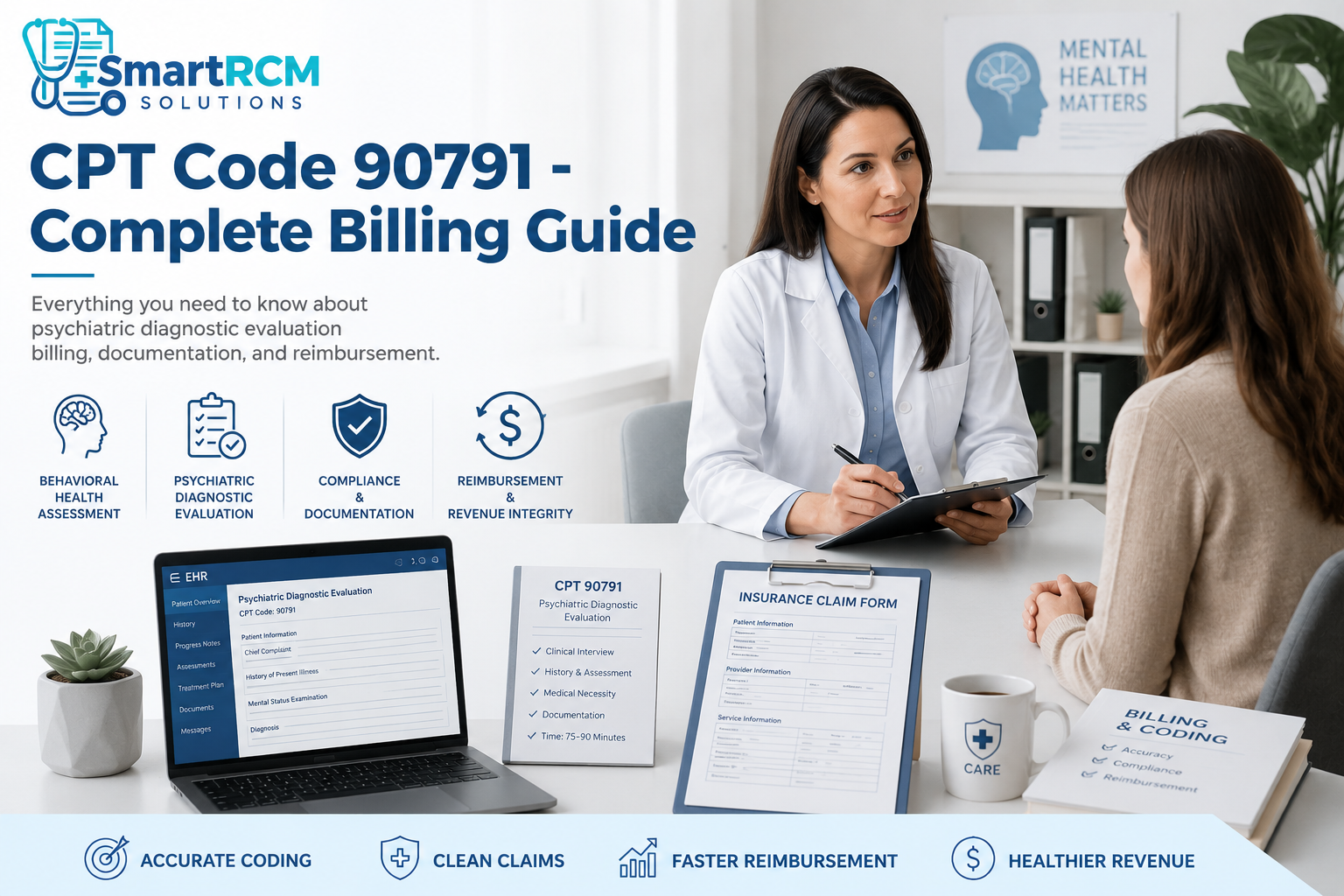
Mental health providers frequently use CPT 90791 when performing an initial psychiatric assessment. This code represents one of the most important services in behavioral health because it establishes the clinical foundation for diagnosis, treatment planning, and ongoing care.

CPT 90791 – A detailed Guide
Accurate reporting of CPT 90791 helps providers support medical necessity, improve reimbursement outcomes, reduce claim denials, and maintain compliance with payer requirements. However, many providers still struggle with documentation standards, telehealth billing rules, frequency limitations, and the differences between CPT 90791 and CPT 90792.
This comprehensive guide explains everything providers need to know about CPT 90791, including billing guidelines, documentation requirements, reimbursement considerations, telehealth reporting, common claim denials, and compliance best practices.
CPT Code 90791
CPT code 90791 is used to report a psychiatric diagnostic evaluation without medical services. Providers use this code during an initial behavioral health assessment to gather psychiatric history, evaluate symptoms, perform a mental status examination, establish diagnoses, assess risk factors, and develop a treatment plan. CPT 90791 does not include medication management or medical services. When medical services are provided during the evaluation, CPT 90792 may be appropriate instead.
CPT 90791 at a Glance
| Category | Details |
|---|---|
| CPT Code | 90791 |
| Description | Psychiatric Diagnostic Evaluation |
| Medical Services Included | No |
| Medication Management Included | No |
| Time Requirement | Not Time-Based |
| Common Provider Types | Psychologists, LPCs, LCSWs, LMFTs |
| Telehealth Eligible | Often Yes (Payer Dependent) |
| Common Use | Initial Behavioral Health Assessment |
What Is CPT 90791?
CPT 90791 is the psychiatric diagnostic evaluation code used to report a comprehensive behavioral health assessment without medical services.
Providers typically use this code during a patient’s initial visit when gathering information necessary to establish a diagnosis and create a treatment plan.
Unlike psychotherapy codes, CPT 90791 focuses on evaluation rather than treatment. The provider collects clinical information, assesses symptoms, reviews psychiatric history, evaluates psychosocial factors, and determines appropriate next steps for care.
Because the service establishes the clinical framework for future treatment, accurate documentation is essential.
Why CPT 90791 Matters
Behavioral health treatment begins with a thorough assessment. Consequently, CPT 90791 serves as the entry point into the patient’s treatment journey.
A properly completed psychiatric diagnostic evaluation helps providers:
- Establish accurate diagnoses
- Identify safety concerns
- Assess suicide risk
- Evaluate psychosocial stressors
- Determine treatment needs
- Develop individualized care plans
- Support medical necessity
- Improve treatment outcomes
Additionally, payers often review CPT 90791 claims carefully because this service frequently initiates a course of treatment.
Services Commonly Included in CPT 90791
Although every evaluation differs based on patient needs, CPT 90791 commonly includes several assessment components.
Clinical Interview
Providers gather information regarding:
- Presenting complaints
- Current symptoms
- Psychiatric concerns
- Treatment goals
Psychiatric History
The evaluation often includes review of:
- Previous diagnoses
- Prior treatment episodes
- Hospitalizations
- Counseling history
- Medication history
Family History
Providers may assess:
- Family psychiatric conditions
- Genetic risk factors
- Family support systems
Social History
Important psychosocial information may include:
- Employment status
- Educational background
- Living arrangements
- Relationship dynamics
- Substance use history
Mental Status Examination
The provider evaluates:
- Appearance
- Behavior
- Mood
- Affect
- Thought process
- Thought content
- Insight
- Judgment
Risk Assessment
Providers frequently assess:
- Suicide risk
- Self-harm risk
- Homicidal ideation
- Safety concerns
Diagnostic Formulation
The evaluation typically concludes with:
- Clinical impressions
- Diagnosis
- Treatment recommendations
- Follow-up planning
Who Can Bill CPT 90791?
Several behavioral health professionals may report CPT 90791 when allowed under payer policies.
Common provider types include:
- Clinical Psychologists
- Licensed Clinical Social Workers (LCSWs)
- Licensed Professional Counselors (LPCs)
- Marriage and Family Therapists (LMFTs)
- Behavioral Health Specialists
- Other Qualified Mental Health Professionals
However, credentialing requirements vary among insurance plans. Therefore, providers should verify payer-specific policies before billing CPT 90791.
Common Clinical Scenarios for CPT 90791
Understanding real-world examples can help providers determine when CPT 90791 may be appropriate.
New Anxiety Patient
A patient presents with chronic anxiety, sleep disturbances, and panic attacks. The psychologist performs a comprehensive psychiatric assessment, reviews mental health history, evaluates symptom severity, and develops an initial treatment plan.
CPT 90791 may be appropriate.
Depression Evaluation
A behavioral health provider evaluates a patient referred by a primary care physician due to symptoms of depression. The assessment includes a psychiatric interview, risk evaluation, mental status examination, and treatment recommendations.
CPT 90791 may be reported.
Adolescent Behavioral Assessment
A therapist evaluates a teenager experiencing behavioral concerns, academic difficulties, and emotional challenges. The provider gathers information from both the patient and family members before establishing treatment recommendations.
CPT 90791 may support this service when documentation meets payer requirements.
CPT 90791 Documentation Requirements
Accurate documentation is one of the most important factors in successful CPT 90791 billing. Even when providers select the correct code, insufficient documentation can lead to claim denials, delayed payments, audits, and compliance concerns.
Because CPT 90791 represents a psychiatric diagnostic evaluation, the medical record should clearly demonstrate that the provider performed a comprehensive behavioral health assessment rather than a psychotherapy session.
Additionally, documentation should support medical necessity and explain why the evaluation was clinically appropriate.
Required Documentation Elements for CPT 90791
Although payer requirements may vary, providers should generally document the following components.
Chief Complaint
The record should explain why the patient is seeking behavioral health services.
Examples include:
- Anxiety symptoms
- Depression concerns
- Mood instability
- Behavioral issues
- Trauma-related symptoms
- Sleep disturbances
History of Present Illness (HPI)
The evaluation should include a detailed description of:
- Symptom onset
- Symptom duration
- Severity
- Frequency
- Functional impact
- Triggering factors
Strong documentation helps establish medical necessity and supports diagnostic decision-making.
Psychiatric History
Providers should review:
- Previous diagnoses
- Prior therapy services
- Psychiatric hospitalizations
- Medication history
- Previous treatment outcomes
This information often provides valuable clinical context.
Family History
Family history may include:
- Depression
- Anxiety disorders
- Bipolar disorder
- Schizophrenia
- Substance use disorders
- Suicide history
Understanding family history can support diagnostic accuracy and treatment planning.
Social History
The evaluation should often address:
- Employment status
- Educational background
- Living situation
- Family relationships
- Support systems
- Substance use
- Legal concerns
These factors frequently influence treatment outcomes.
Mental Status Examination (MSE)
A Mental Status Examination is commonly considered one of the most important components of CPT 90791 documentation.
Providers typically evaluate:
- Appearance
- Behavior
- Speech
- Mood
- Affect
- Thought process
- Thought content
- Cognition
- Insight
- Judgment
Comprehensive MSE documentation strengthens the clinical record and supports the assessment process.
Risk Assessment
Behavioral health providers should evaluate potential safety concerns.
Examples include:
- Suicidal ideation
- Self-harm risk
- Homicidal ideation
- Safety planning needs
- Crisis intervention requirements
Risk assessment documentation is especially important when patients present with severe symptoms.
Diagnosis
The provider should document:
- Clinical impressions
- DSM-based diagnosis
- Differential diagnoses when appropriate
A clear diagnosis helps support future treatment services and payer review.
Treatment Recommendations
The evaluation should conclude with a plan for future care.
Examples include:
- Individual therapy
- Family therapy
- Group counseling
- Psychiatric medication evaluation
- Telehealth follow-up visits
- Referral recommendations
CPT 90791 Documentation Checklist
Providers can use the following checklist before claim submission.
✓ Chief Complaint
✓ History of Present Illness
✓ Psychiatric History
✓ Family History
✓ Social History
✓ Mental Status Examination
✓ Risk Assessment
✓ Diagnosis
✓ Treatment Plan
✓ Provider Signature
Completing this checklist may help reduce denials and strengthen audit readiness.
Common Documentation Mistakes
Many behavioral health organizations experience denials because documentation does not adequately support CPT 90791.
Common errors include:
❌ Missing Mental Status Examination
❌ Incomplete psychiatric history
❌ Missing diagnosis
❌ Missing treatment recommendations
❌ Insufficient risk assessment
❌ Generic documentation templates
❌ Copy-and-paste notes
❌ Missing provider signature
Implementing routine chart audits can help identify these issues before claims are submitted.
CPT 90791 Reimbursement Considerations
One of the most common questions providers ask is:
“How much does CPT 90791 reimburse?”
The answer depends on several factors.
Factors Affecting Reimbursement
Reimbursement may vary based on:
- Geographic location
- Payer contract terms
- Provider credentials
- Facility type
- Commercial insurance policies
- Medicare requirements
- Medicaid programs
Consequently, there is no universal reimbursement amount for CPT 90791.
Why Accurate Documentation Impacts Reimbursement
Payers frequently review psychiatric diagnostic evaluations because these services establish treatment plans and support future behavioral health claims.
Incomplete documentation may result in:
- Payment delays
- Medical record requests
- Claim denials
- Audit reviews
Therefore, documentation quality directly influences reimbursement success.
Revenue Cycle Best Practice
Behavioral health organizations should periodically review:
- Denial trends
- Payment patterns
- Documentation compliance
- Authorization requirements
This proactive approach can improve revenue cycle performance and reduce preventable claim issues.
CPT 90791 Telehealth Billing
Telehealth continues to play an important role in behavioral health care delivery.
Many payers allow providers to perform psychiatric diagnostic evaluations remotely when specific requirements are met.
However, telehealth billing rules vary among insurance carriers.
Providers should always verify current payer guidance before claim submission.
Can CPT 90791 Be Billed Via Telehealth?
In many cases, yes.
Qualified providers may perform psychiatric diagnostic evaluations through approved telehealth platforms when payer policies permit remote assessments.
Telehealth services should generally involve:
- Real-time audio and video communication
- Appropriate patient consent
- Compliance with payer requirements
- Complete clinical documentation
Telehealth Documentation Requirements
When reporting CPT 90791 through telehealth, providers should document:
- Patient consent
- Telehealth platform used
- Patient location
- Provider location
- Confirmation of remote service delivery
- Clinical findings
- Assessment results
Failure to document telehealth-specific elements may increase denial risk.
POS for CPT 90791 Telehealth Billing
Selecting the correct Place of Service code is critical.
POS 02 for CPT 90791
POS 02 generally indicates that telehealth services were delivered while the patient was located somewhere other than their home.
Examples include:
- School
- Community clinic
- Residential facility
POS 10 for CPT 90791
POS 10 generally indicates that telehealth services were delivered while the patient was located at home.
Because many behavioral health evaluations occur remotely, POS 10 has become increasingly common.
Modifier 95 for CPT 90791
Modifier 95 is frequently reported when eligible telehealth services are provided using real-time audio and video communication technology.
Example Telehealth Claim
| Field | Value |
|---|---|
| CPT Code | 90791 |
| Modifier | 95 |
| POS | 10 |
| Service Type | Telehealth Psychiatric Diagnostic Evaluation |
Providers should verify payer-specific modifier requirements before billing.
CPT 90791 vs CPT 90792
One of the most frequently searched billing questions involves understanding the difference between CPT 90791 and CPT 90792.
Although both codes represent psychiatric diagnostic evaluations, they are not interchangeable.
| Feature | CPT 90791 | CPT 90792 |
| Psychiatric Evaluation | Yes | Yes |
| Medical Services Included | No | Yes |
| Medication Assessment | No | Yes |
| Medical Decision-Making | Limited | Included |
| Medication Management | No | Yes |
| Common Providers | Therapists, Psychologists | Psychiatrists, PMHNPs |
When to Use CPT 90791
Providers generally use CPT 90791 when performing a psychiatric diagnostic evaluation that does not include medical services.
When to Use CPT 90792
Providers generally use CPT 90792 when the evaluation includes:
- Medication review
- Medical assessment
- Pharmacological considerations
- Medical decision-making
Selecting the correct code is essential for both compliance and reimbursement.
Common CPT 90791 Claim Denials
Despite being a commonly reported behavioral health code, CPT 90791 claims may still be denied.
The most frequent denial reasons include:
Missing Documentation
Incomplete evaluations often trigger payer requests or denials.
Frequency Limitations
Some payers limit how often CPT 90791 may be billed.
Incorrect Provider Type
Credentialing restrictions may apply.
Missing Telehealth Requirements
Claims may fail if required modifiers or POS codes are omitted.
Unsupported Medical Necessity
Documentation should clearly explain why the evaluation was needed.
Providers who proactively address these issues can significantly improve claim acceptance rates.
CPT 90791 Frequency Limitations
One of the most overlooked billing considerations involves frequency limitations for CPT 90791.
Although CPT 90791 is commonly used for initial psychiatric diagnostic evaluations, most payers do not expect providers to bill this code repeatedly without a clinically justified reason.
Consequently, providers should understand payer-specific frequency guidelines before submitting claims.
Why Frequency Limits Exist
Insurance companies generally view CPT 90791 as an intake or diagnostic assessment service.
Therefore, repeated billing may trigger:
- Medical record reviews
- Claim denials
- Pre-payment audits
- Post-payment audits
Payers often expect providers to transition patients into psychotherapy, medication management, or ongoing behavioral health treatment after the initial assessment.
Situations That May Support a Repeat CPT 90791
Although rules vary, repeat evaluations may be appropriate when:
- A patient returns after a long treatment gap
- Significant clinical changes occur
- A new diagnosis is suspected
- A major life event impacts treatment planning
- A payer specifically allows reassessment services
Providers should always document the reason for the repeat evaluation.
Same-Day Billing Rules for CPT 90791
Behavioral health providers frequently ask whether CPT 90791 can be billed on the same day as other services.
The answer depends on payer policies, documentation, and the services performed.
Can CPT 90791 and Psychotherapy Be Billed on the Same Day?
Some payers may allow same-day billing under specific circumstances.
However, documentation must clearly demonstrate that:
- The psychiatric diagnostic evaluation was completed
- The psychotherapy service was separately identifiable
- Medical necessity supports both services
Because payer requirements vary, providers should verify coverage guidelines before billing.
Can CPT 90791 and CPT 90792 Be Billed Together?
In most situations, providers should not bill CPT 90791 and CPT 90792 for the same patient encounter.
Since both codes represent psychiatric diagnostic evaluations, reporting both services together may create claim issues.
Best Practice
Before submitting same-day claims:
✓ Review payer policy
✓ Verify coding guideline
✓ Confirm documentation supports separate services
✓ Ensure medical necessity is clearly documented
Prior Authorization Requirements For CPT Code 90791
Many behavioral health providers assume CPT 90791 never requires authorization.
However, some payers may impose authorization requirements depending on:
- Plan type
- Benefit structure
- State regulations
- Behavioral health carve-outs
Therefore, providers should always verify benefits before the appointment.
Authorization Verification Checklist
Before the evaluation:
✓ Confirm active coverage
✓ Verify behavioral health benefits
✓ Check authorization requirements
✓ Confirm network participation
✓ Document verification details
A few minutes spent verifying benefits can prevent weeks of payment delays.
Common Audit Risks for CPT 90791
Because CPT 90791 serves as the foundation for behavioral health treatment, payers frequently review these claims.
Understanding common audit triggers helps providers strengthen compliance efforts.
Insufficient Documentation
The most common audit issue involves incomplete documentation.
Examples include:
- Missing psychiatric history
- Missing diagnosis
- Missing treatment recommendations
- Incomplete Mental Status Examination
Repeated Billing
Frequent use of CPT 90791 without adequate clinical justification may attract payer scrutiny.
Providers should document why a repeat evaluation was medically necessary.
Copy-and-Paste Documentation
Repeated templates that lack individualized patient information may raise compliance concerns.
Strong documentation should reflect the patient’s unique clinical presentation.
Unsupported Medical Necessity
Documentation should explain:
- Why the evaluation was needed
- What symptoms were assessed
- How findings impacted treatment planning
Without medical necessity support, reimbursement may be challenged.
How to Prevent CPT 90791 Claim Denials
Denial prevention begins before the patient encounter.
Organizations that implement strong front-end processes often experience fewer payment issues.
Verify Insurance Eligibility
Confirm:
- Active coverage
- Behavioral health benefits
- Authorization requirements
- Network participation
Conduct a Thorough Evaluation
The psychiatric diagnostic evaluation should address all required assessment components.
Comprehensive evaluations often result in stronger documentation and cleaner claims.
Document Medical Necessity
Medical necessity should be evident throughout the record.
The provider should clearly explain:
- Presenting symptoms
- Functional impairments
- Diagnostic concerns
- Treatment recommendations
Review Telehealth Requirements
For remote evaluations, verify:
- Modifier requirements
- POS codes
- Telehealth documentation standards
Perform Claim Scrubbing
Before claim submission:
✓ Verify CPT code accuracy
✓ Confirm diagnosis coding
✓ Validate payer requirement
✓ Review provider credentials
✓ Check telehealth information
Reimbursement Optimization Tips
Improving reimbursement involves more than selecting the correct CPT code.
Successful organizations typically focus on the entire revenue cycle.
Improve Documentation Quality
Strong documentation supports:
- Medical necessity
- Claim acceptance
- Audit readiness
- Reimbursement success
Monitor Denial Trends
Regular denial analysis helps organizations identify:
- Coding issues
- Documentation gaps
- Eligibility problems
- Authorization challenges
Educate Providers
Provider education can improve:
- Documentation consistency
- Coding accuracy
- Compliance performance
- Revenue integrity
Conduct Internal Audits
Routine chart reviews help identify issues before payers discover them.
As a result, organizations can correct deficiencies proactively.
Real CPT 90791 Billing Example
Scenario
A new patient schedules an appointment due to anxiety, panic attacks, and worsening depression symptoms.
A licensed psychologist performs a comprehensive psychiatric diagnostic evaluation.
Services Performed
The provider documents:
- Psychiatric history
- Family history
- Social history
- Mental Status Examination
- Risk assessment
- Diagnosis
- Treatment recommendations
Claim Example
| Field | Value |
|---|---|
| CPT Code | 90791 |
| Diagnosis | F41.1 |
| Provider | Clinical Psychologist |
| POS | 11 |
| Modifier | None |
| Service Type | Psychiatric Diagnostic Evaluation |
This claim may support reimbursement when documentation satisfies payer requirements.
Telehealth CPT 90791 Example
Scenario
A patient participates in an initial psychiatric evaluation from home using a secure telehealth platform.
The psychologist completes the assessment remotely.
Claim Example
| Field | Value |
| CPT Code | 90791 |
| Modifier | 95 |
| POS | 10 |
| Service Type | Telehealth Psychiatric Evaluation |
Documentation includes:
- Telehealth consent
- Patient location
- Provider location
- Clinical assessment
- Treatment recommendations
Frequently Asked Questions
Q. What is CPT 90791 used for?
A. CPT 90791 is used to report a psychiatric diagnostic evaluation without medical services.
Q. Does CPT code 90791 include medication management?
A. No. CPT 90791 does not include medication management or medical services.
Q. Is CPT 90791 time-based?
A. No. Unlike psychotherapy codes, CPT 90791 is not a time-based service.
Q. Can CPT 90791 be billed through telehealth?
A. Many payers allow telehealth billing for CPT 90791 when telehealth requirements are met.
Q. What modifier is commonly used with telehealth CPT 90791 claims?
A. Modifier 95 is commonly used when payer guidelines require telehealth identification.
Q. What is the difference between CPT 90791 and CPT 90792?
A. CPT 90791 does not include medical services, while CPT 90792 includes medical assessment and medication-related services.
Q. Can CPT 90791 be billed more than once?
A. Possibly. However, repeat billing generally requires clinical justification and payer approval.
Q. Why are CPT 90791 claims denied?
A. Common reasons include incomplete documentation, frequency limitations, authorization issues, credentialing problems, and unsupported medical necessity.
Q. Who can bill CPT 90791?
A. Qualified behavioral health professionals may report CPT 90791 when payer requirements are met.
Q. Does Medicare cover CPT 90791?
A. Coverage depends on provider eligibility, patient benefits, and applicable Medicare policies.
Conclusion
CPT 90791 is one of the most important Mental Health CPT Codes because it establishes the clinical foundation for diagnosis, treatment planning, and ongoing behavioral health care. Providers use this code to perform comprehensive psychiatric diagnostic evaluations that assess symptoms, psychiatric history, risk factors, psychosocial influences, and treatment needs.
Furthermore, successful CPT 90791 billing requires accurate documentation, proper telehealth reporting, medical necessity support, and compliance with payer-specific requirements. By understanding frequency limitations, authorization requirements, audit risks, reimbursement considerations, and denial prevention strategies, providers can improve claim acceptance rates and strengthen revenue cycle performance.
Organizations that combine strong clinical documentation with effective billing workflows are often better positioned to reduce denials, maintain compliance, and achieve consistent reimbursement outcomes.