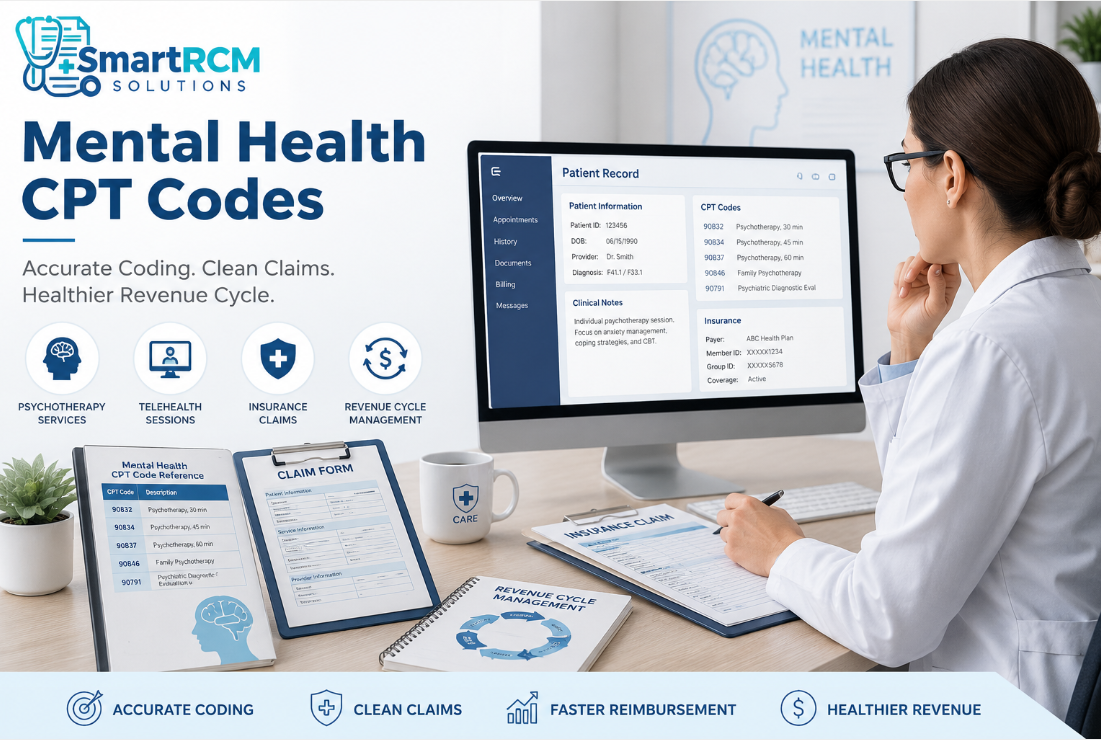
Mental Health CPT Codes play a critical role in behavioral health billing, reimbursement, compliance, and revenue cycle management. Behavioral and Mental health providers rely on these codes to report psychiatric evaluations, psychotherapy sessions, family counseling services, group therapy, and behavioral health assessments to insurance payers.
Mental Health CPT Codes
CPT Codes for Mental Health are standardized procedure codes used to report psychiatric evaluations, psychotherapy services, family counseling, group therapy, and behavioral health assessments. Common Mental Health CPT Codes include CPT 90791, 90792, 90832, 90834, 90837, 90846, 90847, 90853, and 96127. Correct code selection, documentation, modifier usage, and telehealth compliance help providers reduce claim denials and improve reimbursement accuracy.
Accurate use of Mental Health CPT Codes helps providers submit cleaner claims, reduce payment delays, minimize denials, and improve reimbursement outcomes. Whether services are delivered in person or through telehealth, understanding the correct CPT code, modifier, documentation requirements, and place of service (POS) code is essential for successful claim submission.
Additionally, this guide explains the most commonly used Mental Health CPT Codes, billing rules, documentation requirements, telehealth considerations, modifier usage, common denial causes, and best practices for behavioral health providers.
Mental Health CPT Codes at a Glance
| CPT Code | Description | Common Use |
|---|---|---|
| 90791 | Psychiatric Diagnostic Evaluation | Initial psychiatric assessment |
| 90792 | Psychiatric Diagnostic Evaluation with Medical Services | Evaluation including medication review |
| 90832 | Psychotherapy, 30 Minutes | Brief therapy session |
| 90834 | Psychotherapy, 45 Minutes | Standard psychotherapy session |
| 90837 | Psychotherapy, 60 Minutes | Extended psychotherapy session |
| 90846 | Family Therapy Without Patient | Family counseling |
| 90847 | Family Therapy With Patient | Family therapy involving patient |
| 90853 | Group Psychotherapy | Group counseling sessions |
| 96127 | Behavioral Assessment | Emotional or behavioral screening |
What Are Mental Health CPT Codes?
Mental Health CPT Codes are procedure codes developed to standardize the reporting of behavioral health services. These codes allow healthcare providers and insurance companies to communicate consistently regarding the services delivered to patients.
Mental health professionals use these codes to report services such as:
- Psychiatric diagnostic evaluations
- Individual psychotherapy
- Family counseling
- Group psychotherapy
- Behavioral health screenings
- Teletherapy visits
- Medication management services
Insurance carriers use CPT codes to determine:
- Medical necessity
- Coverage eligibility
- Reimbursement amounts
- Authorization requirements
- Claims processing decisions
Without accurate CPT coding, providers may face delayed payments, denied claims, compliance concerns, and increased administrative burdens.
Why Accurate Mental Health CPT Coding Matters
Behavioral health billing is often more complex than many providers realize. Because most mental health services involve time-based coding requirements, detailed documentation standards, and payer-specific reimbursement rules.
Using the correct Mental Health CPT Codes provides several benefits.
Reduces Claim Denials
One of the most common reasons mental health claims are denied is incorrect coding. Reporting the wrong psychotherapy code or failing to support the service with proper documentation can result in claim rejection.
For example, billing CPT 90837 without documenting sufficient session time may trigger a denial or audit review.
Improves Reimbursement Accuracy
Different Mental Health CPT Codes reimburse at different rates. Selecting the correct code ensures providers are compensated appropriately for the services performed.
Accurate coding helps prevent:
- Underbilling
- Lost revenue
- Payment delays
- Claim corrections
Supports Regulatory Compliance
Insurance companies, Medicare programs, and commercial payers require providers to maintain documentation that supports billed services.
Proper coding and documentation help organizations:
- Meet compliance standards
- Prepare for audits
- Demonstrate medical necessity
- Reduce recoupment risks
Strengthens Revenue Cycle Performance
Clean claims move through the revenue cycle more efficiently.
Benefits include:
- Faster payments
- Fewer denials
- Reduced rework
- Improved cash flow
- Better operational efficiency
Most Common Mental Health CPT Codes
Understanding the most frequently reported Mental Health CPT Codes helps providers select the most appropriate code for each patient encounter.
CPT 90791 – Psychiatric Diagnostic Evaluation
CPT 90791 is used for a psychiatric diagnostic evaluation that does not include medical services.
This code is commonly reported when a provider performs a comprehensive behavioral health assessment during an initial visit.
The evaluation typically includes:
- Mental health history
- Social history
- Family history
- Mental status examination
- Risk assessment
- Diagnostic formulation
- Initial treatment recommendations
Who Commonly Bills CPT 90791?
The following providers may commonly report CPT 90791 when allowed by payer policy:
- Psychologists
- Licensed Clinical Social Workers
- Licensed Professional Counselors
- Marriage and Family Therapists
- Behavioral Health Specialists
Documentation Requirements for CPT 90791
Documentation should generally include:
- Chief complaint
- Presenting symptoms
- Psychiatric history
- Family history
- Social history
- Mental status findings
- Risk assessment
- Diagnosis
- Treatment recommendations
Real-World Example
A psychologist evaluates a new patient experiencing symptoms of anxiety and depression. During the visit, the provider completes a comprehensive psychiatric assessment, develops a treatment plan, and documents all findings. CPT 90791 may be appropriate for reporting this service.
Common Billing Mistakes for CPT 90791
Many denials occur because providers:
- Submit incomplete evaluations
- Lack sufficient documentation
- Bill duplicate assessments
- Ignore payer frequency limitations
Verifying payer requirements before claim submission can help reduce these issues.
CPT 90792 – Psychiatric Diagnostic Evaluation with Medical Services
CPT 90792 is similar to CPT 90791 but includes medical services provided during the evaluation.
This code is frequently reported by providers who can assess medical conditions, review medications, and make treatment decisions involving pharmacological management.
Who Commonly Bills CPT 90792?
Typical providers include:
- Psychiatrists
- Psychiatric Mental Health Nurse Practitioners
- Qualified Medical Professionals
Services Commonly Included in CPT 90792
A psychiatric diagnostic evaluation with medical services may include:
- Psychiatric assessment
- Medical history review
- Medication review
- Medication management planning
- Physical health considerations
- Diagnostic decision-making
Documentation Requirements for CPT 90792
Documentation should support:
- Psychiatric evaluation
- Medical assessment
- Medication review
- Clinical decision-making
- Diagnosis
- Treatment recommendations
Real-World Example
A psychiatrist evaluates a patient with major depressive disorder, reviews current medications, assesses treatment effectiveness, and develops a medication management strategy. Because medical services are included, CPT 90792 may be appropriate.
CPT 90791 vs CPT 90792
One of the most common questions in behavioral health billing involves understanding the difference between CPT 90791 and CPT 90792.
| Feature | CPT 90791 | CPT 90792 |
|---|---|---|
| Psychiatric Evaluation | Yes | Yes |
| Medical Services Included | No | Yes |
| Medication Assessment | No | Yes |
| Medical Decision-Making | Limited | Included |
| Common Provider Types | Therapists, Psychologists | Psychiatrists, PMHNPs |
| Medication Management | No | Yes |
Understanding this distinction helps providers avoid coding errors and ensure claims accurately reflect the services performed.
CPT 90832 – Psychotherapy, 30 Minutes
CPT 90832 is used to report an individual psychotherapy session lasting approximately 30 minutes. This code is commonly billed when a provider delivers focused therapeutic interventions during a shorter counseling session.
Among Mental Health CPT Codes, CPT 90832 is often used for follow-up visits where the patient requires ongoing support but does not need a longer psychotherapy session.
When to Use CPT 90832
Providers may consider CPT 90832 when:
- Treating mild to moderate anxiety
- Managing depression symptoms
- Providing stress management counseling
- Addressing adjustment disorders
- Conducting brief psychotherapy sessions
The service should involve active therapeutic intervention rather than simple check-ins or administrative discussions.
Documentation Requirements for CPT 90832
Documentation should generally include:
- Session duration
- Patient symptoms
- Therapeutic techniques used
- Treatment goals
- Patient response
- Progress toward objectives
- Follow-up plan
Accurate time documentation is especially important because psychotherapy codes are time-based.
Real-World Example
A therapist meets with a patient experiencing workplace stress and mild anxiety. During the session, the provider uses cognitive behavioral therapy techniques, reviews coping strategies, and updates the treatment plan. CPT 90832 may be appropriate when documentation supports the session duration and services provided.
Common Billing Mistakes
Common errors include:
- Missing session duration
- Insufficient progress notes
- Billing psychotherapy when only supportive discussion occurred
- Failing to establish medical necessity
CPT 90834 – Psychotherapy, 45 Minutes
CPT 90834 is one of the most frequently billed psychotherapy codes in behavioral health practices.
This code is commonly used when a provider conducts an individual psychotherapy session lasting approximately 45 minutes.
Many mental health providers consider CPT 90834 the standard psychotherapy code because it often aligns with typical outpatient counseling appointments.
Common Clinical Uses
CPT 90834 is frequently reported for:
- Anxiety disorders
- Major depressive disorder
- PTSD treatment
- Behavioral health counseling
- Trauma therapy
- Relationship challenges
- Stress-related conditions
Documentation Requirements
Documentation should support:
- Session duration
- Treatment objectives
- Therapeutic interventions
- Clinical observations
- Patient participation
- Progress assessment
- Future treatment recommendations
Real-World Example
A licensed therapist provides a 45-minute psychotherapy session for a patient receiving treatment for generalized anxiety disorder. The provider documents symptom improvement, therapeutic interventions, treatment goals, and progress made during the session. CPT 90834 may be appropriate.
Why CPT 90834 Is Commonly Used
Many providers find that 45-minute sessions:
- Fit patient schedules
- Allow meaningful therapeutic work
- Meet payer expectations
- Balance clinical needs and productivity
CPT 90837 – Psychotherapy, 60 Minutes
CPT 90837 is used to report extended psychotherapy sessions lasting approximately 60 minutes.
Among all psychotherapy-related Mental Health CPT Codes, CPT 90837 often receives the greatest payer scrutiny due to its higher reimbursement potential.
Providers should ensure that documentation clearly supports the duration and complexity of care delivered.
When CPT 90837 May Be Appropriate
Situations may include:
- Severe depression
- Complex trauma
- PTSD treatment
- Crisis intervention
- Multiple coexisting behavioral health conditions
- Intensive psychotherapy needs
Documentation Requirements for CPT 90837
Strong documentation should support:
- Session duration
- Clinical complexity
- Medical necessity
- Treatment goals
- Therapeutic interventions
- Patient response
- Progress assessment
Revenue Cycle Tip
Many behavioral health denials occur because providers bill CPT 90837 but fail to adequately document the need for an extended session.
Payers frequently review:
- Time documentation
- Medical necessity
- Treatment intensity
- Progress notes
Real-World Example
A therapist conducts a 60-minute psychotherapy session with a patient experiencing severe PTSD symptoms following a traumatic event. The session includes cognitive processing interventions, symptom assessment, coping strategy development, and treatment planning. Documentation supports both duration and medical necessity. CPT 90837 may be appropriate.
Audit Risk Alert
Repeated use of CPT 90837 without clear clinical justification may increase audit risk.
Providers should avoid:
- Copy-and-paste progress notes
- Generic documentation
- Unsupported session durations
- Inconsistent treatment records
CPT 90834 vs CPT 90837
One of the most common billing questions involves understanding the difference between CPT 90834 and CPT 90837.
| Feature | CPT 90834 | CPT 90837 |
|---|---|---|
| Service Type | Psychotherapy | Psychotherapy |
| Typical Duration | 45 Minutes | 60 Minutes |
| Clinical Complexity | Moderate | Often Higher |
| Documentation Requirements | Standard | More Detailed |
| Reimbursement Potential | Moderate | Higher |
| Audit Scrutiny | Moderate | Higher |
Which Code Should Be Used?
Providers should never select a psychotherapy code based solely on reimbursement.
Instead, code selection should reflect:
- Actual session duration
- Medical necessity
- Clinical circumstances
- Documentation support
CPT 90846 – Family Psychotherapy Without the Patient Present
CPT 90846 is reported when family psychotherapy services are provided without the patient being present.
Family involvement often plays a critical role in successful behavioral health treatment.
Common Uses of CPT 90846
- Parent counseling
- Caregiver education
- Behavioral intervention planning
- Family support training
- Treatment compliance discussions
Example Scenario
A therapist meets with parents of a child diagnosed with ADHD to discuss behavioral management techniques and treatment goals. The patient is not present during the session. CPT 90846 may be appropriate.
Documentation Requirements
Documentation should include:
- Individuals present
- Clinical purpose
- Discussion topics
- Interventions provided
- Impact on patient treatment
CPT 90847 – Family Psychotherapy With Patient Present
CPT 90847 is used when family psychotherapy involves both the patient and family members.
This service focuses on improving communication, strengthening support systems, and addressing family dynamics affecting treatment outcomes.
Common Clinical Situations
- Parent-child counseling
- Family conflict resolution
- Behavioral interventions
- Relationship challenges
- Treatment planning sessions
Real-World Example
A therapist conducts a session involving an adolescent patient and both parents to address treatment compliance concerns and communication difficulties. CPT 90847 may be reported when documentation supports the service.
Documentation Essentials
Include:
- Participants present
- Treatment objectives
- Family interactions observed
- Therapeutic interventions
- Progress toward goals
CPT 90853 – Group Psychotherapy
CPT 90853 is used to report psychotherapy services provided in a group setting.
Group therapy allows multiple patients to participate in structured therapeutic interventions led by a qualified behavioral health professional.
Conditions Commonly Addressed
- Anxiety disorders
- Depression
- PTSD
- Substance use disorders
- Grief counseling
- Social skills development
Benefits of Group Therapy
Group psychotherapy can help patients:
- Develop coping skills
- Gain peer support
- Improve communication
- Reduce social isolation
- Learn from shared experiences
Documentation Requirements
Providers should document:
- Group topic
- Therapeutic interventions
- Patient participation
- Clinical observations
- Treatment progress
Common Billing Error
Many providers fail to document individual patient participation within the group session. This omission may increase denial risk.
CPT 96127 – Brief Emotional or Behavioral Assessment
CPT 96127 is used to report brief emotional or behavioral assessments administered through standardized screening instruments.
This code is commonly reported in both primary care and behavioral health settings.
Common Screening Tools
Examples include:
- PHQ-9
- GAD-7
- Depression screening tools
- Anxiety assessments
- Behavioral health questionnaires
Why CPT 96127 Is Important
Behavioral health screenings help identify mental health concerns early and support timely intervention.
Benefits include:
- Earlier diagnosis
- Improved treatment planning
- Better patient outcomes
- Enhanced care coordination
Documentation Requirements
Documentation should include:
- Assessment tool used
- Results obtained
- Clinical interpretation
- Follow-up recommendations
Real-World Example
A provider administers a PHQ-9 depression screening during a follow-up visit. Results indicate worsening symptoms and support adjustments to the treatment plan. CPT 96127 may be reported when payer requirements are met.
Common Billing Mistakes Across Mental Health CPT Codes
Behavioral health providers frequently encounter preventable denials because of coding and documentation issues.
Most Common Mistakes
❌ Missing session duration
❌ Incorrect psychotherapy code selection
❌ Insufficient medical necessity
❌ Missing treatment goals
❌ Incomplete progress notes
❌ Unsupported telehealth claims
❌ Incorrect modifier usage
❌ Wrong POS code selection
Implementing regular documentation reviews can significantly reduce these errors and improve reimbursement outcomes.
Mental Health CPT Codes for Telehealth Services
Telehealth has transformed the way mental health services are delivered. Many behavioral health providers now offer psychotherapy, psychiatric evaluations, medication management, and counseling services remotely, allowing patients to access care from home or other approved locations.
Because telehealth billing requirements continue to evolve, providers must understand how Mental Health CPT Codes interact with telehealth modifiers, place of service codes, documentation standards, and payer-specific policies.
Incorrect telehealth billing remains one of the leading causes of claim denials in behavioral health.
Why Telehealth Billing Matters
Mental health services are among the most commonly delivered telehealth services in the United States.
Telehealth can help:
- Improve patient access
- Reduce missed appointments
- Increase treatment continuity
- Expand behavioral health services into underserved areas
- Improve patient satisfaction
However, providers must ensure claims accurately reflect how services were delivered.
Common Mental Health CPT Codes Used for Telehealth
Several Mental Health CPT Codes are commonly billed through telehealth.
| CPT Code | Description | Telehealth Eligible (Payer Dependent) |
|---|---|---|
| 90791 | Psychiatric Diagnostic Evaluation | Yes |
| 90792 | Psychiatric Diagnostic Evaluation with Medical Services | Yes |
| 90832 | 30-Minute Psychotherapy | Yes |
| 90834 | 45-Minute Psychotherapy | Yes |
| 90837 | 60-Minute Psychotherapy | Yes |
| 90846 | Family Therapy Without Patient | Often Yes |
| 90847 | Family Therapy With Patient | Often Yes |
| 90853 | Group Psychotherapy | Often Yes |
| 96127 | Behavioral Assessment | May Vary |
Always verify payer-specific requirements before billing telehealth services.
POS Codes for Mental Health Billing
Place of Service (POS) codes help payers understand where healthcare services were delivered.
Using the wrong POS code can result in claim denials, payment delays, and reimbursement issues.
For telehealth mental health services, two POS codes are particularly important.
POS 02 – Telehealth Provided Other Than in Patient’s Home
POS 02 is generally used when telehealth services are provided while the patient is located somewhere other than their home.
Examples include:
- School
- Assisted living facility
- Community health center
- Residential treatment facility
Example of POS 02
A therapist conducts a virtual psychotherapy session with a patient located at a university counseling center.
The claim may include:
- CPT 90834
- Modifier 95
- POS 02
POS 10 – Telehealth Provided in Patient’s Home
POS 10 is used when the patient receives telehealth services from their home.
This code has become increasingly important because many mental health visits now occur while patients are at home.
Example of POS 10
A psychologist provides a 60-minute teletherapy session to a patient connecting from their residence.
The claim may include:
- CPT 90837
- Modifier 95
- POS 10
POS 02 vs POS 10
One of the most searched questions in mental health billing involves choosing the correct POS code.
| Feature | POS 02 | POS 10 |
|---|---|---|
| Telehealth Service | Yes | Yes |
| Patient at Home | No | Yes |
| Patient at Another Location | Yes | No |
| Common Mental Health Usage | Moderate | Very High |
Quick Rule
Patient at home = POS 10
Patient not at home = POS 02
Modifier 95 for Mental Health Billing
Modifier 95 is one of the most important modifiers used in behavioral health telehealth billing.
It indicates that a qualifying service was provided through real-time interactive audio and video telecommunications technology.
When Modifier 95 Is Commonly Used
Modifier 95 may be appended to:
- CPT 90791
- CPT 90792
- CPT 90832
- CPT 90834
- CPT 90837
- CPT 90846
- CPT 90847
when payer policies allow telehealth reporting.
Real Billing Example
A therapist performs a 45-minute psychotherapy session through a HIPAA-compliant telehealth platform.
Claim Example:
| Field | Value |
|---|---|
| CPT Code | 90834 |
| Modifier | 95 |
| POS | 10 |
Common Modifier 95 Errors
Many denied claims involve:
- Missing Modifier 95
- Wrong POS code
- Unsupported telehealth documentation
- Incorrect CPT code selection
Modifier 25 in Mental Health Billing
Modifier 25 indicates that a significant and separately identifiable Evaluation and Management (E/M) service was performed on the same day as another procedure or service.
Why Modifier 25 Matters
Mental health providers occasionally perform:
- Evaluation services
- Medical assessments
- Psychotherapy services
during the same encounter.
When documentation supports separate services, Modifier 25 may be appropriate according to payer rules.
Example Scenario
A psychiatrist performs:
- Evaluation and Management service
- Medication review
- Psychotherapy session
during the same patient encounter.
Depending on documentation and payer requirements, Modifier 25 may be necessary.
Documentation Tips
Documentation should clearly demonstrate:
- Separate services performed
- Medical necessity
- Distinct work completed
Modifier GT
Although Modifier 95 is widely used today, some payers continue to recognize Modifier GT for telehealth services.
Modifier GT historically indicated:
Service delivered via interactive audio and video telecommunications systems.
Modifier GT vs Modifier 95
| Feature | Modifier GT | Modifier 95 |
|---|---|---|
| Telehealth Indicator | Yes | Yes |
| Common Today | Limited | Very Common |
| Payer Specific | Often | Yes |
| Behavioral Health Usage | Some Plans | Many Plans |
Providers should always follow individual payer guidelines regarding telehealth modifiers.
Documentation Requirements for Mental Health CPT Codes
Documentation is one of the most important components of successful behavioral health billing.
Even when the correct CPT code is selected, insufficient documentation can lead to denials, audits, and payment recoupments.
Mental Health Documentation Checklist
Every mental health encounter should generally include:
Patient Information
- Patient name
- Date of service
- Provider information
Clinical Information
- Presenting symptoms
- Diagnosis
- Treatment goals
- Medical necessity
Session Information
- Start time
- End time
- Total duration
- Type of service provided
Therapeutic Interventions
- CBT techniques
- Behavioral interventions
- Trauma-focused therapy
- Counseling strategies
Patient Progress
- Symptom changes
- Treatment response
- Progress toward goals
Follow-Up Plan
- Future appointments
- Treatment recommendations
- Medication considerations
Telehealth Documentation Requirements
Telehealth encounters should also include:
- Patient consent
- Telehealth platform used
- Patient location
- Provider location
- Confirmation of remote service delivery
Common Claim Denials in Mental Health Billing
Behavioral health providers frequently encounter denials that could have been prevented through proper coding and documentation.
Denial Reason #1 – Missing Documentation
Insufficient documentation remains one of the most common denial causes.
Examples:
- Missing progress notes
- Missing session duration
- Missing treatment goals
Denial Reason #2 – Incorrect CPT Code
Using a psychotherapy code that does not match the service performed may result in denial.
Denial Reason #3 – Wrong Modifier
Telehealth claims submitted without required modifiers often fail payer edits.
Denial Reason #4 – Incorrect POS Code
Reporting POS 02 when the patient was at home may trigger claim issues.
Denial Reason #5 – Medical Necessity Not Supported
Documentation must demonstrate why treatment was clinically necessary.
Denial Reason #6 – Authorization Issues
Some payers require prior authorization for specific mental health services.
Failure to obtain authorization may lead to denied claims.
Revenue Leakage Risks in Mental Health Billing
Many behavioral health organizations lose revenue without realizing it.
Common causes include:
- Underbilling services
- Missing modifiers
- Coding inaccuracies
- Authorization failures
- Incomplete documentation
- Missed charge capture
Regular chart audits can help identify revenue leakage opportunities.
How to Prevent Mental Health CPT Code Denials
The best denial management strategy is prevention.
1. Verify Eligibility
Confirm:
- Active coverage
- Behavioral health benefits
- Authorization requirements
2. Select the Correct CPT Code
Match the service provided to the documentation.
3. Verify Modifiers
Ensure telehealth modifiers are reported when required.
4. Confirm POS Codes
Use POS 02 or POS 10 appropriately.
5. Support Medical Necessity
Documentation should clearly justify treatment.
6. Review Claims Before Submission
Perform claim scrubbing to identify:
- Missing information
- Coding errors
- Modifier issues
- POS issues
Audit Risks and Compliance Considerations
Behavioral health claims are frequently reviewed by payers and government programs.
Understanding audit risks helps providers reduce compliance exposure.
Common Audit Triggers
Common audit triggers are under as follow.
Excessive Use of CPT 90837
Repeated billing of 60-minute psychotherapy sessions without strong clinical support may attract payer attention.
Missing Time Documentation
Psychotherapy services are time-based.
Failure to document duration can create compliance concerns.
Copy-and-Paste Notes
Repeated documentation may raise questions about medical necessity.
Unsupported Medical Necessity
Treatment records should explain why services were required.
Incomplete Treatment Plans
Providers should maintain updated treatment plans reflecting patient goals and progress.
Mental Health Billing Compliance Checklist
✓ CPT code accurately reflects service
✓ Session duration documented
✓ Medical necessity supported
✓ Treatment goals documented
✓ Modifier verified
✓ POS code verified
✓ Authorization obtained
✓ Progress note completed
✓ Telehealth requirements met
✓ Claim reviewed before submission.
Real Mental Health Billing Claim Example
Understanding how Mental Health CPT Codes appear on an actual claim can help providers and billing teams reduce coding errors and improve claim acceptance rates.
Example 1: In-Person Psychotherapy Session
Patient Encounter
A licensed therapist provides a 45-minute psychotherapy session for a patient diagnosed with Generalized Anxiety Disorder (GAD).
Claim Information
| Field | Value |
|---|---|
| CPT Code | 90834 |
| Diagnosis Code | F41.1 |
| Modifier | None |
| POS | 11 |
| Provider Type | Licensed Therapist |
| Service Type | Individual Psychotherapy |
Documentation Included
- Session duration
- Treatment goals
- CBT interventions
- Progress assessment
- Follow-up plan
This claim would generally be considered complete when documentation supports medical necessity and payer requirements.
Example 2: Telehealth Psychotherapy Session
Patient Encounter
A psychologist conducts a 60-minute psychotherapy session through a secure telehealth platform.
Claim Information
| Field | Value |
| CPT Code | 90837 |
| Modifier | 95 |
| POS | 10 |
| Diagnosis | F32.A |
| Service Type | Telehealth Psychotherapy |
Documentation Included
- Patient consent
- Telehealth platform
- Session duration
- Treatment interventions
- Progress notes
Real-World Mental Health Billing Scenario
Scenario
A patient experiencing anxiety and depression schedules an initial evaluation with a behavioral health provider.
Visit 1
Psychiatric Diagnostic Evaluation
Code:
90791
Documentation:
- Mental health history
- Family history
- Risk assessment
- Diagnosis
- Treatment plan
Visit 2
45-Minute Psychotherapy Session
Code:
90834
Documentation:
- CBT techniques
- Symptom review
- Progress notes
- Treatment goals
Visit 3
Telehealth Follow-Up
Code:
90834
Modifier:
95
POS:
10
Documentation:
- Telehealth consent
- Session duration
- Patient progress
This workflow represents a common behavioral health treatment journey and demonstrates how multiple Mental Health CPT Codes may be used throughout a patient’s course of care.
Mental Health CPT Codes Cheat Sheet
Psychiatric Evaluation Codes
| CPT Code | Description |
| 90791 | Psychiatric Diagnostic Evaluation |
| 90792 | Psychiatric Diagnostic Evaluation with Medical Services |
Psychotherapy Codes
| CPT Code | Description |
| 90832 | 30-Minute Psychotherapy |
| 90834 | 45-Minute Psychotherapy |
| 90837 | 60-Minute Psychotherapy |
Family Therapy Codes
| CPT Code | Description |
| 90846 | Family Therapy Without Patient |
| 90847 | Family Therapy With Patient |
Other Mental Health CPT Codes
| CPT Code | Description |
| 90853 | Group Psychotherapy |
| 96127 | Behavioral Assessment |
Related Mental Health CPT Codes
Providers researching Mental Health CPT Codes frequently seek information about:
- CPT 90791
- CPT 90792
- CPT 90832
- CPT 90834
- CPT 90837
- CPT 90846
- CPT 90847
- CPT 90853
- CPT 96127
These codes often work together within behavioral health treatment plans and should be understood as part of a broader mental health billing strategy.
Frequently Asked Questions
Q. What are Mental Health CPT Codes?
A. Mental Health CPT Codes are procedure codes used to report psychiatric evaluations, psychotherapy sessions, family counseling, behavioral health assessments, and other mental health services.
Q. Which CPT code is used for psychotherapy?
A. The most common psychotherapy codes are CPT 90832, CPT 90834, and CPT 90837.
Q. What is the difference between CPT 90791 and CPT 90792?
A. CPT 90791 is used for psychiatric evaluations without medical services, while CPT 90792 includes medical assessment and medication-related services.
Q. What is the difference between CPT 90834 and CPT 90837?
A. CPT 90834 is generally used for a 45-minute psychotherapy session, while CPT 90837 is reported for a 60-minute psychotherapy session when documentation supports the additional time.
Q. Which modifier is commonly used for telehealth psychotherapy?
A. Modifier 95 is commonly used to indicate eligible telehealth services.
Q. Should POS 02 or POS 10 be used for teletherapy?
A. POS 10 is generally used when the patient is located at home, while POS 02 is typically used when the patient receives telehealth services from another location.
Q. Does Medicare cover Mental Health CPT Codes?
A. Coverage depends on the specific service, patient eligibility, and Medicare billing requirements.
Q. What documentation is required for CPT 90837?
A. Documentation should support session duration, medical necessity, treatment goals, interventions performed, and patient progress.
Q. Can CPT 90791 and CPT 90834 be billed on the same day?
A. Some payers may allow same-day billing under specific circumstances. Providers should verify payer policies before submitting claims.
References and Research Sources
For the most current billing guidance, providers should review:
- Current CPT code resources
- CMS billing guidance
- Medicare behavioral health policies
- Commercial payer policies
- Telehealth billing regulations
- Behavioral health compliance guidance
Because payer requirements may change, providers should verify all coding, modifier, reimbursement, and telehealth rules with the applicable payer before claim submission.
Conclusion
Mental Health CPT Codes are essential for reporting psychiatric evaluations, psychotherapy sessions, family counseling, group therapy, and behavioral health assessments. Understanding the differences between CPT 90791, 90792, 90832, 90834, 90837, 90846, 90847, 90853, and 96127 helps providers submit accurate claims and improve reimbursement outcomes.
Successful mental health billing requires more than selecting the correct CPT code. Providers must also understand telehealth requirements, POS code selection, modifier usage, documentation standards, medical necessity requirements, denial prevention strategies, and audit risks.
By implementing accurate coding practices, maintaining detailed documentation, and following payer-specific billing requirements, behavioral health organizations can reduce denials, strengthen compliance, and improve overall revenue cycle performance.