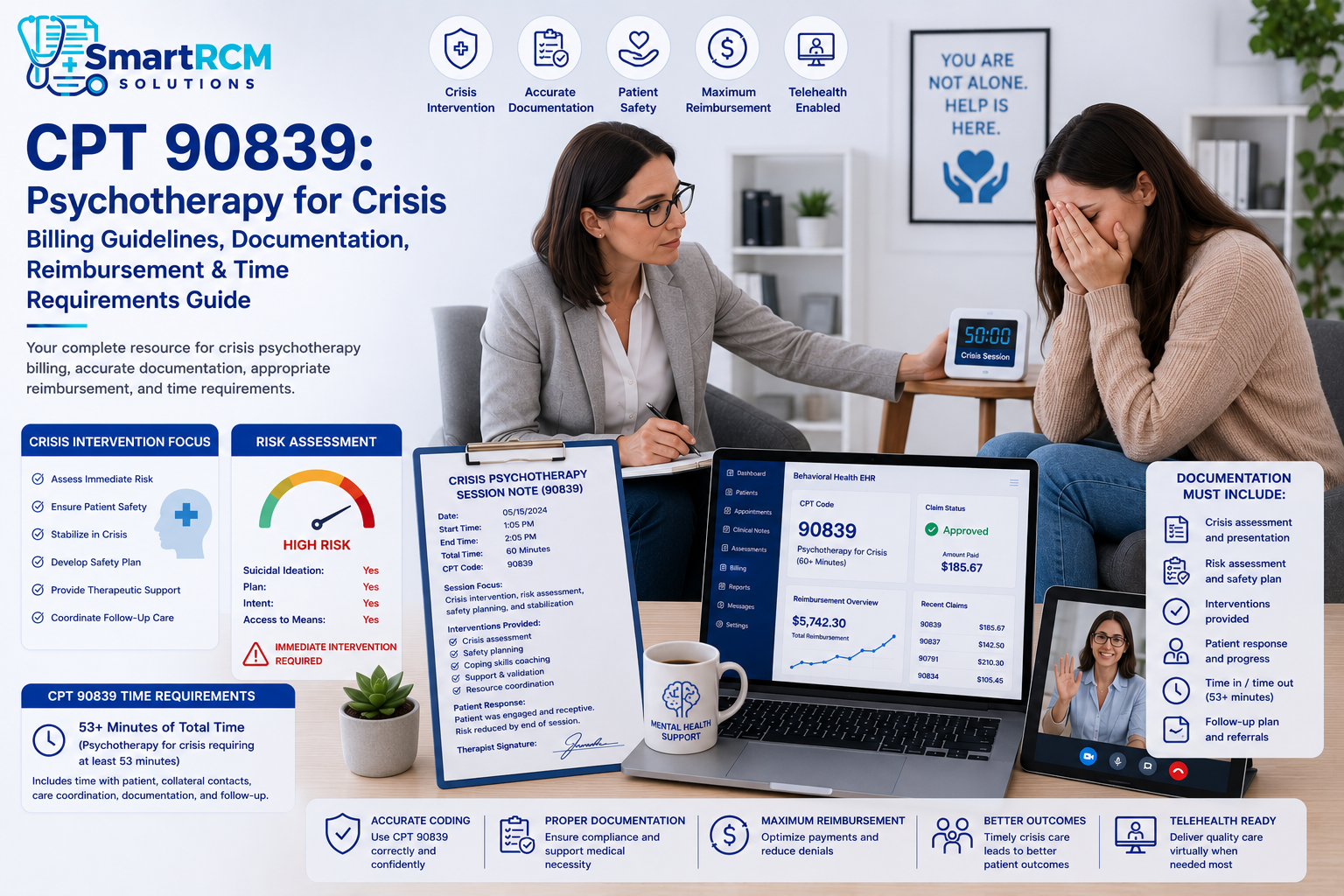
Behavioral health professionals frequently encounter patients experiencing acute psychological crises that require immediate intervention. These situations often involve severe emotional distress, suicidal ideation, homicidal thoughts, traumatic events, psychiatric emergencies, or significant impairment in daily functioning. CPT 90839 allows providers to report psychotherapy services delivered during these crisis situations.
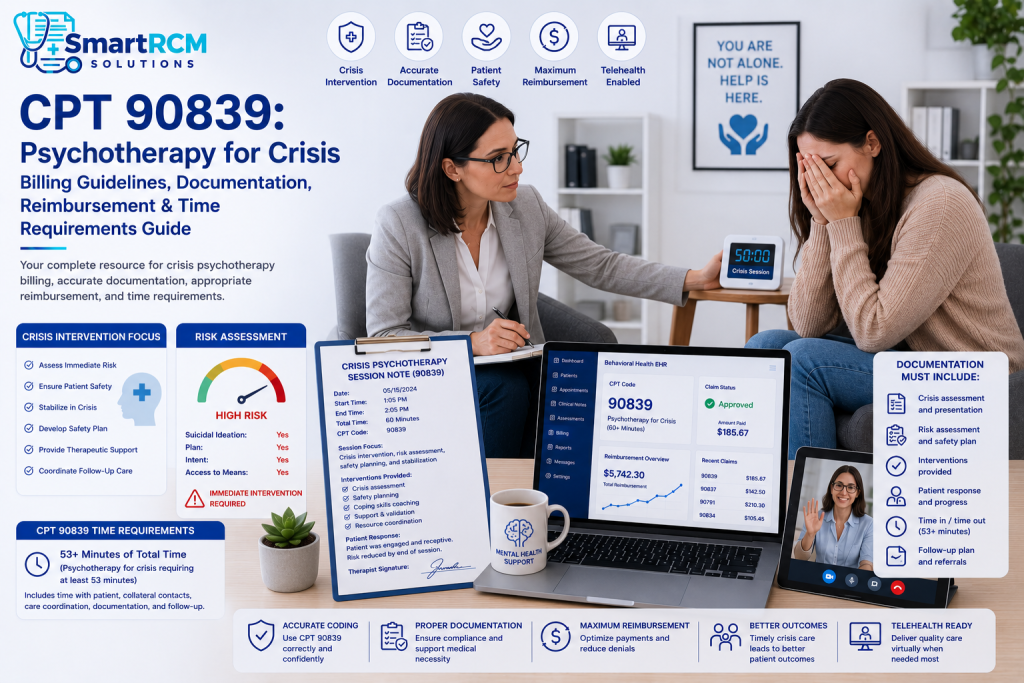
CPT 90839 – A Detailed Guide
Unlike traditional psychotherapy codes, CPT 90839 has specific time requirements and documentation expectations. Therefore, providers must understand when crisis psychotherapy is appropriate, how to document services correctly, and how to avoid common billing mistakes.
This guide explains the CPT 90839 description, time requirements, documentation standards, reimbursement considerations, and denial prevention strategies.
CPT 90839 Quick Answer
CPT 90839 describes psychotherapy for crisis involving an urgent assessment and intervention for a patient experiencing a mental health crisis. The code covers the first 60 minutes of crisis psychotherapy services.
CPT 90839 Description
Understanding the official CPT code description is essential before billing crisis intervention services.
CPT 90839 describes psychotherapy for crisis, first 60 minutes.
Crisis psychotherapy involves urgent assessment and treatment of a patient whose mental status presents an immediate danger to themselves, others, or their ability to function safely.
The provider’s focus is stabilizing the crisis, reducing immediate risk, and developing an appropriate treatment or safety plan.
CPT Code 90839 Description at a Glance
| Category | Details |
|---|---|
| CPT Code | 90839 |
| Description | Psychotherapy for Crisis, First 60 Minutes |
| Service Type | Crisis Intervention |
| Time Requirement | 60 Minutes |
| Add-On Code | CPT 90840 |
| Specialty | Psychiatry & Behavioral Health |
| Documentation Required | Yes |
CPT 90839 Time Requirement
The CPT 90839 time requirement is one of the most important billing considerations.
Unlike CPT 90832, CPT 90834, and CPT 90837, crisis psychotherapy codes are directly tied to time.
First 60 Minutes
CPT 90839 covers the first 60 minutes of crisis psychotherapy services.
The service includes:
- Crisis assessment
- Mental status evaluation
- Risk assessment
- Safety planning
- Crisis intervention
- Treatment coordination
CPT 90840 Add-On Code
When crisis psychotherapy extends beyond the first hour, providers may report CPT 90840.
CPT 90840 Description
CPT 90840 describes each additional 30 minutes of crisis psychotherapy.
Example
| Service Time | Code |
| 60 Minutes | CPT 90839 |
| 90 Minutes | CPT 90839 + CPT 90840 |
| 120 Minutes | CPT 90839 + CPT 90840 + CPT 90840 |
Accurate time documentation is critical when reporting CPT 90840.
When Should Providers Use CPT 90839?
Providers report CPT Code 90839 when patients require immediate intervention because of a behavioral health crisis.
Common situations include:
- Suicidal ideation
- Suicide attempts
- Homicidal ideation
- Severe panic attacks
- Acute psychosis
- Major traumatic events
- Severe depression with safety concerns
- Psychiatric emergencies
- Significant functional impairment
Additionally, providers may use CPT 90839 when immediate intervention prevents hospitalization or further deterioration.
Who Can Bill CPT 90839?
Several behavioral health professionals may report Crisis Psychotherapy Code 90839 when payer requirements are met.
Common provider types include:
- Psychiatrists
- Psychologists
- Licensed Clinical Social Workers (LCSWs)
- Licensed Professional Counselors (LPCs)
- Licensed Mental Health Counselors (LMHCs)
- Other qualified behavioral health professionals
Provider eligibility varies by payer and state regulations.
CPT 90839 Documentation Requirements
Documentation must clearly establish that a crisis existed and that immediate intervention was necessary.
Clinical Presentation
Document:
- Nature of the crisis
- Symptoms presented
- Risk factors
- Functional impairment
Risk Assessment
Include:
- Suicide risk assessment
- Homicide risk assessment
- Safety concerns
- Protective factors
Crisis Intervention Provided
Document:
- Therapeutic interventions
- Safety planning
- Family involvement when appropriate
- Treatment coordination
Time Documentation
Record:
- Start time
- End time
- Total face-to-face time
- Additional crisis intervention time when applicable
Strong documentation is essential because crisis psychotherapy claims often receive additional scrutiny.
CPT 90839 vs CPT 90837
One of the most common coding questions involves understanding the difference between 90839 and CPT 90837.
Although both codes involve psychotherapy services, thei code is reserved for crisis situations requiring immediate intervention.
| Feature | CPT 90837 | CPT 90839 |
|---|---|---|
| Service Type | Individual Psychotherapy | Crisis Psychotherapy |
| Typical Duration | 60 Minutes | First 60 Minutes of Crisis Intervention |
| Crisis Required | No | Yes |
| Risk Assessment | Not Required | Required |
| Safety Planning | Not Typically Required | Usually Required |
| Add-On Code Available | No | CPT 90840 |
When to Use CPT 90837
Use CPT 90837 when:
- Providing routine psychotherapy
- Treating anxiety, depression, PTSD, or other conditions without an immediate crisis
- Delivering a standard 60-minute therapy session
When to Use CPT 90839
Use Crisis Psychotherapy CPT Code 90839 when:
- Immediate intervention is necessary
- The patient presents significant safety concerns
- Crisis stabilization is required
- A comprehensive risk assessment is performed
- Treatment focuses on preventing further deterioration
Accurate code selection helps reduce denials and compliance risks.
CPT 90840 Add-On Code
Providers often ask when CPT 90840 should be reported.
What is CPT 90840?
CPT 90840 is an add-on code used for each additional 30 minutes of crisis psychotherapy after the first 60 minutes reported with CPT 90839.
Important Billing Rule
CPT 90840 cannot be billed alone.
Providers must report 90839 first.
Billing Examples
| Total Crisis Time | Billing |
|---|---|
| 60 Minutes | CPT 90839 |
| 90 Minutes | CPT 90839 + CPT 90840 |
| 120 Minutes | CPT 90839 + CPT 90840 + CPT 90840 |
| 150 Minutes | CPT 90839 + CPT 90840 + CPT 90840 + CPT 90840 |
Because reimbursement depends heavily on time documentation, providers should accurately record all crisis intervention time.
CPT 90839 Reimbursement Information
Reimbursement for 90839 is generally higher than standard psychotherapy services because crisis intervention requires increased provider intensity, risk assessment, and immediate treatment planning.
Several factors influence reimbursement:
- Insurance carrier
- Provider specialty
- Geographic location
- Contracted fee schedules
- Documentation quality
- Medical necessity
Because crisis psychotherapy claims often receive additional scrutiny, strong documentation remains essential for successful reimbursement.
Telehealth Billing for CPT 90839
Many payers allow crisis psychotherapy services through telehealth when clinically appropriate.
However, providers should verify payer-specific requirements before billing.
Areas requiring verification include:
✓ Telehealth eligibility
✓ Crisis service coverage
✓ Documentation standards
✓ Modifier requirements
✓ Place of Service reporting
✓ State-specific regulations
Because telehealth policies continue to evolve, providers should review payer guidance regularly.
Modifier 95 for Crisis Psychotherapy
Modifier 95 is commonly reported when crisis psychotherapy services occur through real-time audio and video technology.
Telehealth Billing Example
| CPT Code | Modifier |
|---|---|
| 90839 | 95 |
Documentation should include:
- Patient consent
- Telehealth platform used
- Crisis circumstances
- Risk assessment findings
- Safety planning activities
- Total treatment time
For additional guidance, internally link to Modifier 95 and Mental Health Modifiers.
POS 02 vs POS 10
Telehealth claims require appropriate Place of Service reporting.
| POS Code | Description |
|---|---|
| POS 02 | Telehealth Provided Other Than Patient’s Home |
| POS 10 | Telehealth Provided in Patient’s Home |
Incorrect POS reporting remains a common cause of payment delays.
Real Billing Examples
Suicidal Ideation Crisis Session
A psychologist evaluates a patient experiencing severe suicidal ideation.
Services Performed
- Crisis assessment
- Suicide risk evaluation
- Safety planning
- Family coordination
- Treatment stabilization
Total Time
60 Minutes
Billing
| Service | Code |
|---|---|
| Crisis Psychotherapy | CPT 90839 |
Because the service involved an active behavioral health crisis and lasted 60 minutes, 90839 is appropriate.
Extended Crisis Intervention
A psychiatrist treats a patient experiencing acute psychosis.
Services Performed
- Crisis evaluation
- Safety planning
- Emergency coordination
- Treatment stabilization
Total Time
90 Minutes
Billing
| Service | Code |
|---|---|
| Crisis Psychotherapy | CPT 90839 |
| Additional 30 Minutes | CPT 90840 |
Because services extended beyond the initial hour, CPT 90840 may be reported.
Telehealth Crisis Intervention
A behavioral health provider conducts an emergency telehealth session for a patient experiencing severe panic symptoms and safety concerns.
Billing
| Service | Code |
|---|---|
| Crisis Psychotherapy | CPT 90839 |
| Telehealth Modifier | 95 |
Documentation should support both crisis intervention and telehealth delivery requirements.
Common Billing Mistakes
Several errors frequently lead to denials involving CPT 90839.
Billing CPT 90839 for Routine Therapy
Providers should not report CPT 90839 simply because a session is emotionally difficult.
A true crisis requiring immediate intervention must exist.
Missing Risk Assessment Documentation
Risk assessment is a critical component of crisis psychotherapy.
Failure to document safety concerns may result in claim denial.
Inadequate Time Documentation
Because CPT 90839 and CPT 90840 are time-based services, incomplete time records can create reimbursement problems.
Providers should document:
- Start time
- End time
- Total treatment time
Insufficient Medical Necessity
Documentation must clearly demonstrate:
- Crisis circumstances
- Functional impairment
- Immediate treatment needs
Without this information, payers may deny reimbursement.
Denial Prevention Strategies
Strong workflows help organizations improve reimbursement outcomes.
Verify Benefits Before Treatment
Confirm:
✓ Behavioral health benefits
✓ Crisis intervention coverage
✓ Telehealth eligibility
✓ Authorization requirements
Maintain Comprehensive Documentation
Documentation should support:
- Nature of the crisis
- Risk assessment findings
- Therapeutic interventions
- Safety planning
- Treatment coordination
- Time requirements
Comprehensive records strengthen reimbursement support.
Conduct Regular Audits
Routine audits help identify:
- Documentation deficiencies
- Coding inconsistencies
- Compliance risks
- Reimbursement vulnerabilities
Consequently, providers can improve billing accuracy and reduce future denials.
Educate Clinical Staff
Because crisis psychotherapy billing requirements differ from routine psychotherapy services, ongoing education remains essential.
Frequently Asked Questions
Q. What is CPT 90839?
A. CPT Code 90839 is a crisis psychotherapy code used when a patient requires immediate behavioral health intervention because of an acute psychological crisis, severe emotional distress, or significant safety concerns.
Q. What is the official CPT 90839 description?
A. The official 90839 description is: Psychotherapy for Crisis, First 60 Minutes. The service includes urgent assessment, crisis intervention, safety planning, and treatment stabilization.
Q. What is the 90839 cpt time requirement?
A. CPT 90839 covers the first 60 minutes of crisis psychotherapy. Unlike CPT 90832, CPT 90834, and CPT 90837, this code has a specific time requirement and should only be reported when crisis intervention services are provided.
Q. What is CPT 90840?
A. CPT 90840 is the add-on code used for each additional 30 minutes of crisis psychotherapy after the first 60 minutes reported with CPT 90839. Providers cannot bill CPT 90840 alone.
Q. What is the difference between CPT 90837 and CPT 90839?
A. CPT 90837 reports routine 60-minute psychotherapy sessions. CPT 90839 reports crisis psychotherapy services that involve immediate assessment, intervention, risk management, and stabilization during an active behavioral health crisis.
Q. Can CPT 90839 be billed through telehealth?
A. Yes. Many payers allow telehealth billing for crisis psychotherapy services when providers comply with telehealth requirements and documentation standards. Providers should always verify payer-specific rules before billing.
Conclusion
CPT 90839 is one of the most important behavioral health billing codes for providers who manage psychiatric emergencies and acute psychological crises. Because crisis intervention requires immediate assessment, risk management, safety planning, and treatment stabilization, payers expect providers to maintain detailed documentation that clearly supports medical necessity.
Furthermore, understanding the relationship between CPT 90839 and CPT 90840 helps providers accurately report extended crisis services while reducing compliance risks. Proper time tracking, comprehensive risk assessments, and detailed intervention notes remain essential components of successful crisis psychotherapy billing.
As behavioral health organizations continue expanding crisis response services, accurate reporting of Crisis Psychotherapy CPT Code 90839 can improve reimbursement outcomes while supporting high-quality patient care.