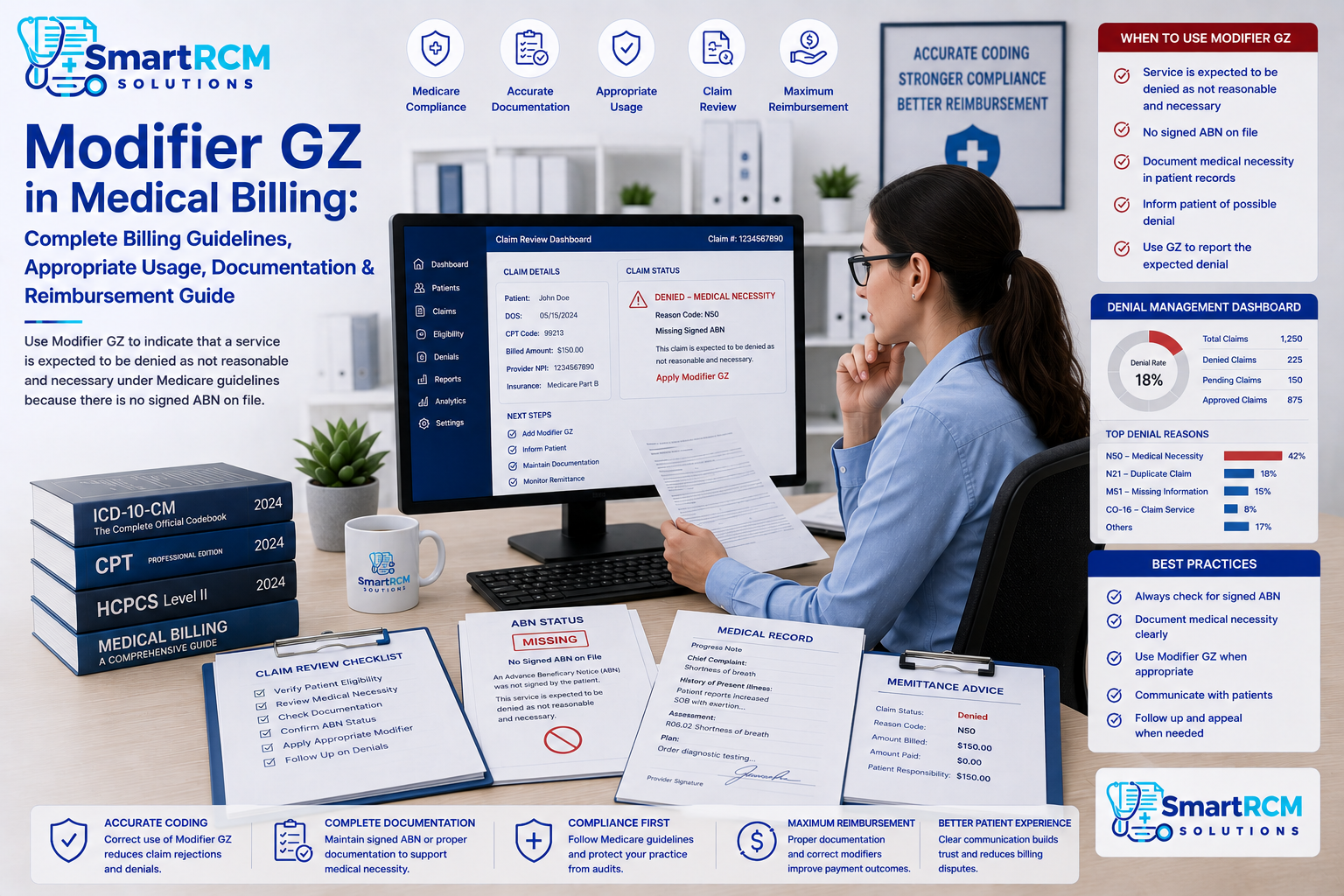
Modifier GZ is reported in medical billing when a healthcare provider expects Medicare to deny a service because it is not considered medically necessary and no Advance Beneficiary Notice (ABN) was obtained before the service was furnished. Correct use of Modifier GZ helps Medicare understand that the provider did not issue an ABN and expects the claim to be denied based on medical necessity.
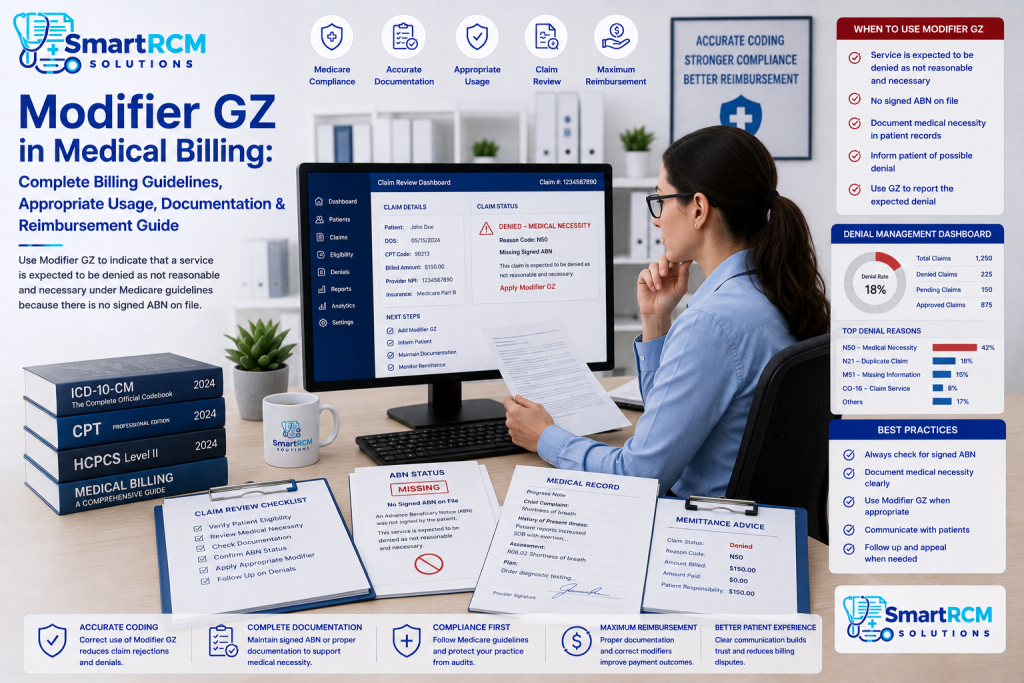
Modifier GZ – A detailed Guide
In this detailed guide here is everything you need to know about GZ modifier. Furthermore, understanding when Modifier GZ applies, how it differs from other Medicare modifiers, and what documentation is required helps providers remain compliant, reduce coding errors, and strengthen revenue cycle management.
Key Information Modifier GZ
| Information | Details |
|---|---|
| Modifier | GZ |
| Description | Item or Service Expected to Be Denied as Not Reasonable and Necessary |
| Category | HCPCS Level II Modifier |
| Primary Payer | Medicare |
| Common Users | Physicians, Hospitals, Outpatient Facilities, Clinics |
| Primary Purpose | Indicates no ABN was obtained for a service expected to be denied for medical necessity |
| Affects Reimbursement | Yes |
| Documentation Required | Yes |
What Is Modifier GZ in Medical Billing?
Modifier GZ tells Medicare that the provider expects a service to be denied because it is not reasonable and necessary under Medicare coverage rules and that no Advance Beneficiary Notice (ABN) was obtained before the service was provided.
Unlike modifiers that document patient notification, Modifier GZ identifies situations where the provider did not secure an ABN even though a denial based on medical necessity is anticipated. Consequently, Medicare processes the claim with the expectation that payment will be denied and that the provider may be financially responsible.
Because Medicare has strict billing requirements regarding ABNs and medical necessity, providers should use Modifier GZ only when it accurately reflects the circumstances of the claim.
Official Modifier GZ Description
The official HCPCS definition of Modifier GZ is:
“Item or service expected to be denied as not reasonable and necessary.”
This definition indicates that the provider expects Medicare to deny the claim because the service does not meet Medicare’s medical necessity requirements and an ABN was not obtained.
When Should Modifier GZ Be Used?
Modifier GZ should only be reported when all of the following conditions apply:
- The provider expects Medicare to deny the service because it is not medically necessary.
- An Advance Beneficiary Notice was not obtained before the service.
- The claim is being submitted to Medicare according to current billing requirements.
Common situations include:
Services Expected to Fail Medical Necessity Requirements
A provider may determine that Medicare is unlikely to consider a service reasonable and necessary based on existing coverage policies. If no ABN was obtained, Modifier GZ may be appropriate.
Billing Compliance
Some providers submit claims with Modifier GZ to accurately reflect the billing circumstances instead of omitting the service entirely. This allows Medicare to process the claim according to its established policies.
Internal Documentation Purposes
Healthcare organizations may also use Modifier GZ to ensure their billing records accurately document why the claim was submitted without an ABN.
When Should Modifier GZ Not Be Used?
Providers should avoid reporting Modifier GZ in the following situations.
An ABN Was Properly Obtained
If the patient signed a valid mandatory ABN before the service, Modifier GZ is not appropriate. Another Medicare modifier may apply instead.
Services Covered by Medicare
Modifier GZ should never be appended to services that fully satisfy Medicare’s medical necessity requirements.
Statutorily Excluded Services
Modifier GZ should not be used for services that are excluded from Medicare benefits by law. Those situations are addressed using different Medicare modifiers.
Modifier GZ vs Modifier GA
Because both modifiers involve Medicare and medical necessity, they are often confused.
| Modifier | Primary Purpose |
|---|---|
| GA | Mandatory ABN obtained before a service expected to be denied for medical necessity. |
| GZ | No ABN obtained for a service expected to be denied for medical necessity. |
Selecting the correct modifier is essential because it directly affects patient liability, claim processing, and Medicare compliance.
Read More: Modifier GX in Medical Billing: Complete Billing & Usage Guide
Documentation Requirements
Although Modifier GZ indicates that no ABN was obtained, providers must still maintain complete documentation supporting the claim.
Documentation should include:
- Physician’s order.
- Clinical documentation supporting the service provided.
- Medical necessity assessment.
- Progress notes.
- Diagnostic findings.
- Claim documentation demonstrating why the provider expected a denial.
Proper documentation supports compliance and prepares the practice for payer audits.
Medicare Billing Guidelines for Modifier GZ
Accurate use of Modifier GZ requires a thorough understanding of Medicare’s medical necessity requirements. Since this modifier indicates that an Advance Beneficiary Notice (ABN) was not obtained before providing a service expected to be denied, providers should review every claim carefully before submission.
Moreover, Modifier GZ should never be used as a routine modifier. Instead, it should only be reported when the billing situation matches Medicare’s official guidance.
Verify Medical Necessity
Before submitting the claim, determine whether the service meets Medicare’s medical necessity requirements. If the service is likely to be denied and no ABN was obtained beforehand, Modifier GZ may be appropriate.
Providers should also review applicable Local Coverage Determinations (LCDs) and National Coverage Determinations (NCDs), when relevant, to confirm whether the service satisfies Medicare’s coverage criteria.
Review Documentation Carefully
Although Modifier GZ indicates that an ABN was not obtained, complete clinical documentation remains essential. Therefore, the patient’s medical record should clearly explain the provider’s clinical decision-making, diagnosis, treatment plan, and the reason the service was performed.
Comprehensive documentation helps support compliance, even when Medicare ultimately denies the claim.
Educate Billing Staff
Because Modifier GZ is frequently confused with other Medicare modifiers, regular staff education is essential. Billing professionals should understand the differences between GA, GX, GY, and GZ so the correct modifier is selected before claim submission.
Reimbursement Considerations
In most situations, Medicare does not reimburse services billed with Modifier GZ because the provider has indicated that the service is expected to be denied for lack of medical necessity and no ABN was obtained.
As a result, providers may become financially responsible when Medicare denies the claim. Consequently, obtaining the appropriate ABN before furnishing services that may not meet medical necessity requirements is often the better approach.
Healthcare organizations should also verify payer-specific billing rules because Medicare Advantage plans and other insurers may have additional documentation or billing requirements.
Real-World Billing Example
A physician orders an advanced diagnostic test for a Medicare beneficiary. Based on Medicare coverage policies, the provider believes the test does not meet the required medical necessity criteria. However, the service is performed without obtaining a mandatory Advance Beneficiary Notice.
Billing Scenario
| Item | Example |
|---|---|
| Service | Diagnostic Procedure |
| Payer | Medicare |
| Modifier | GZ |
| ABN | Not Obtained |
| Expected Outcome | Medicare denies the claim based on medical necessity |
This example illustrates why providers should identify potential coverage issues before treatment whenever possible. Doing so helps avoid unnecessary billing complications and protects both the provider and the patient.
Common Billing Mistakes
Understanding common billing errors helps providers improve coding accuracy while reducing preventable denials.
Confusing Modifier GZ with Modifier GA
This is one of the most frequent coding mistakes. Modifier GA indicates that a mandatory ABN was obtained before the service, whereas Modifier GZ indicates that no ABN was obtained.
Selecting the wrong modifier can affect both claim processing and financial liability.
Using Modifier GZ for Statutorily Excluded Services
Modifier GZ is not intended for services that Medicare excludes by law. Those situations require different Medicare modifiers based on the applicable billing rules.
Reporting Modifier GZ Without Reviewing Coverage Policies
Providers should not assume a service lacks medical necessity. Instead, they should review current Medicare coverage policies and clinical documentation before deciding whether Modifier GZ is appropriate.
Inadequate Documentation
Even though the claim is expected to be denied, incomplete documentation may create additional compliance concerns during audits. Therefore, providers should maintain complete and accurate medical records for every encounter.
Denial Prevention Tips
Preventing Medicare billing problems begins long before the claim is submitted.
First, review Medicare coverage policies to determine whether a service meets medical necessity requirements. Next, identify services that may require a mandatory ABN before treatment. Additionally, educate providers and billing staff on proper modifier selection and documentation standards.
Routine coding audits, documentation reviews, and ongoing Medicare education also help practices reduce billing errors while improving compliance. By taking these proactive steps, healthcare organizations can strengthen revenue cycle performance and minimize avoidable claim denials.
Billing Checklist
Before submitting a claim with Modifier GZ, review this checklist to improve billing accuracy and reduce compliance risks.
- Confirm that the service is expected to be denied because it does not meet Medicare’s medical necessity requirements.
- Verify that no mandatory Advance Beneficiary Notice (ABN) was obtained before the service.
- Ensure Modifier GZ accurately reflects the billing scenario.
- Review the applicable Medicare coverage policy before claim submission.
- Maintain complete clinical documentation supporting the service performed.
- Confirm that the CPT or HCPCS code accurately represents the service.
- Review all modifiers on the claim for accuracy and consistency.
- Perform a final coding review before submitting the claim.
- Conduct periodic audits to identify recurring Modifier GZ billing errors.
You can also check our detailed guides on Modifier 95 and Modifier 90 these are the great resources for billers and providers.
Key Takeaways
Modifier GZ informs Medicare that a provider expects a service to be denied because it is not considered reasonable and necessary and that no Advance Beneficiary Notice was obtained before treatment. Although the modifier helps Medicare process the claim correctly, it does not improve the likelihood of reimbursement. Therefore, providers should verify medical necessity before treatment, issue an ABN whenever required, maintain complete documentation, and educate billing staff on proper modifier selection. These best practices strengthen compliance while reducing preventable billing errors.
Frequently Asked Questions
Q. What is Modifier GZ in medical billing?
A. Modifier GZ is an HCPCS Level II modifier used when a provider expects Medicare to deny a service because it is not considered medically necessary and no mandatory Advance Beneficiary Notice (ABN) was obtained before the service was provided.
Q. When should Modifier GZ be used?
A. Modifier GZ should be reported only when the provider anticipates a Medicare denial based on medical necessity and confirms that an ABN was not issued before the service. It should not be used simply because a denial is possible.
Q. Does Modifier GZ affect reimbursement?
A. Yes. Claims reported with Modifier GZ are generally expected to be denied by Medicare. Since no ABN was obtained, the provider may be financially responsible depending on Medicare’s billing rules.
Q. What is the difference between Modifier GZ and Modifier GA?
A. Modifier GA indicates that a mandatory ABN was obtained before a service expected to be denied for medical necessity. Modifier GZ, however, indicates that no ABN was obtained even though the provider expected the service to be denied.
Q. Can Modifier GZ and Modifier GY be used together?
A. Generally, no. Modifier GZ applies to services expected to be denied because they are not medically necessary, whereas Modifier GY is used for services that are statutorily excluded from Medicare coverage. Since these modifiers represent different billing circumstances, they are not typically reported together.
Q. Is an ABN required when using Modifier GZ?
A. Modifier GZ specifically indicates that an ABN was not obtained. If a mandatory ABN was issued before the service, providers should review Medicare guidance to determine whether another modifier is appropriate.
Q. What documentation should support Modifier GZ?
A. Providers should maintain complete clinical documentation, including the physician’s order, medical record, diagnosis, treatment rationale, progress notes, and any information explaining why the service was performed despite the anticipated Medicare denial.
Q. What are the most common Modifier GZ billing mistakes?
A. Common errors include confusing Modifier GZ with Modifier GA, reporting it for statutorily excluded services, failing to verify Medicare coverage policies, and submitting claims without adequate supporting documentation.
Q. How can providers reduce Modifier GZ claim denials?
A. Providers can improve billing accuracy by reviewing Medicare coverage policies before treatment, obtaining mandatory ABNs when required, educating staff on modifier selection, maintaining complete documentation, and performing regular coding audits.
Q. Does Modifier GZ apply only to Medicare?
A. Modifier GZ is primarily used for Medicare billing. Other insurance companies may have different policies for handling services that do not meet medical necessity requirements, so providers should always review payer-specific guidelines.
Conclusion
Modifier GZ plays a critical role in Medicare billing by identifying services that are expected to be denied because they do not meet medical necessity requirements and were provided without obtaining a mandatory Advance Beneficiary Notice. Although the modifier does not increase the likelihood of payment, it accurately communicates the billing circumstances and helps Medicare process the claim according to established policies.
Furthermore, healthcare providers can reduce billing risks by identifying potential coverage issues before treatment, obtaining mandatory ABNs when appropriate, and maintaining complete documentation. Regular staff training, coding audits, and ongoing review of Medicare guidance also contribute to stronger compliance and a more efficient revenue cycle.