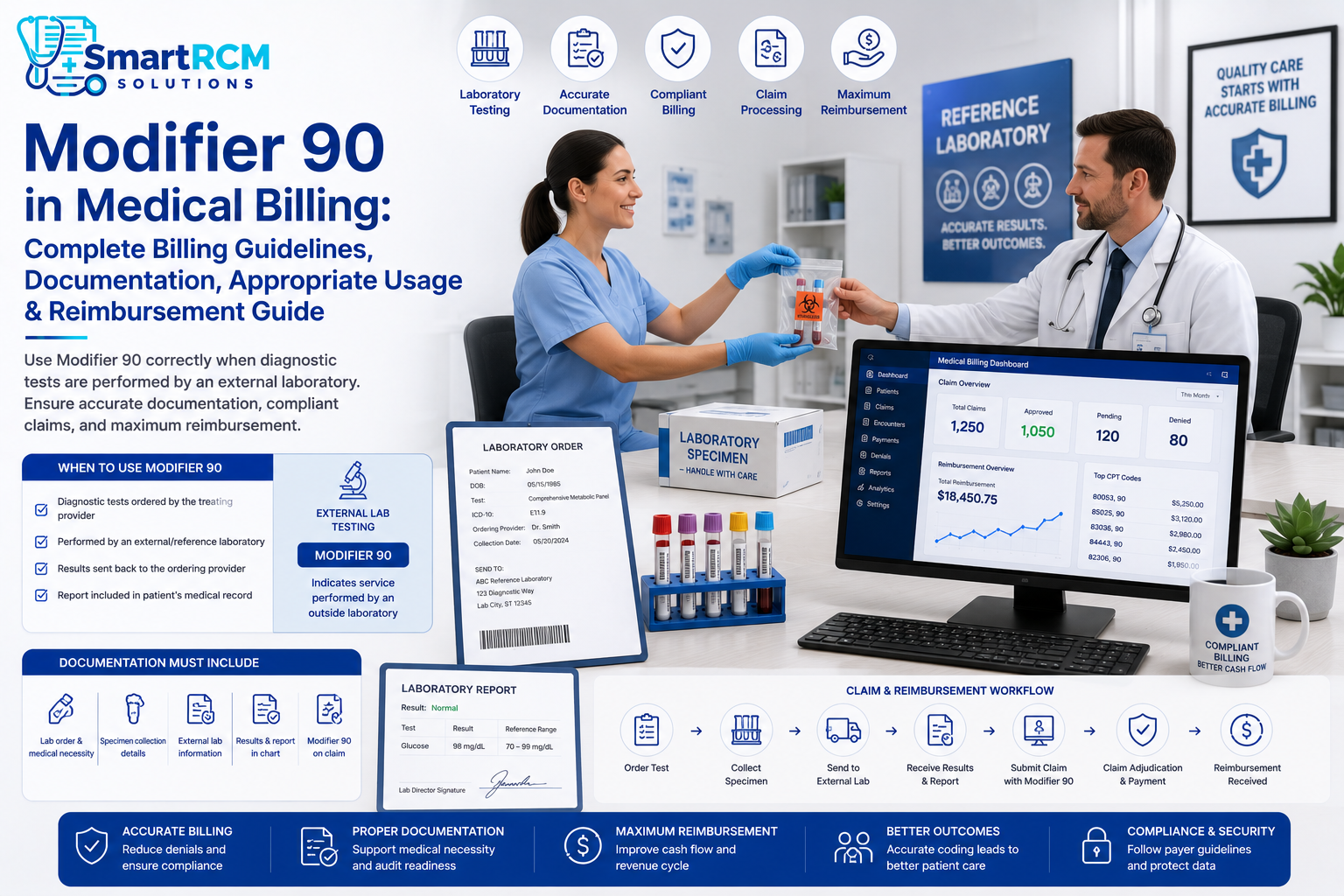
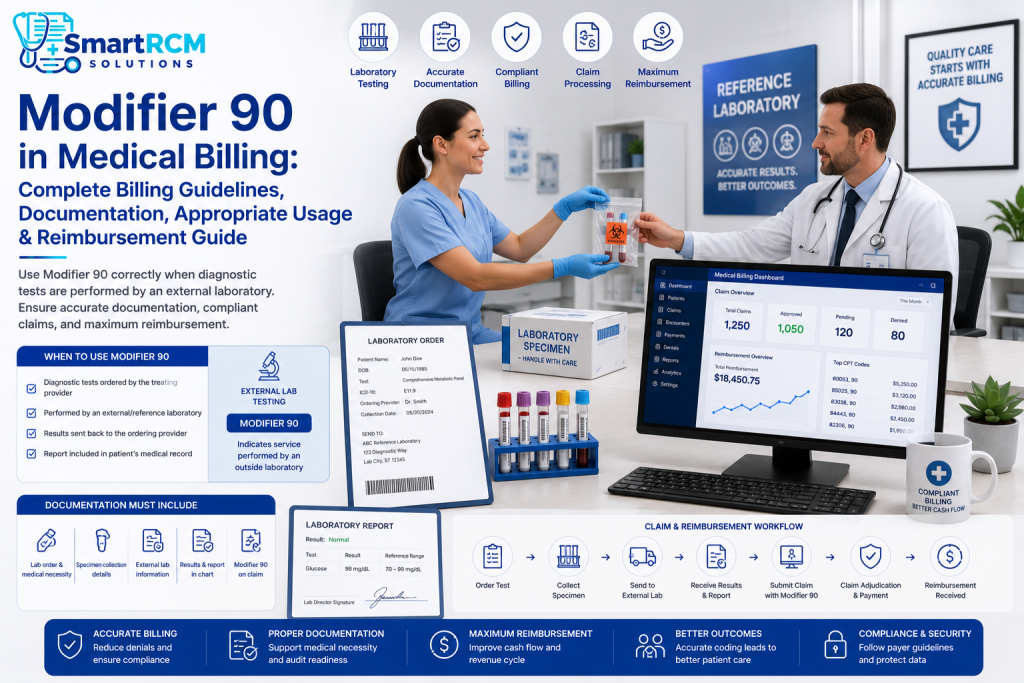
Modifier 90 is used in medical billing when a healthcare provider performs laboratory testing through an outside or reference laboratory instead of conducting the test within their own facility. Correctly reporting Modifier 90 helps identify that the laboratory service was referred to another qualified laboratory for analysis. Additionally, using this modifier appropriately improves claim accuracy, supports proper reimbursement, and helps prevent unnecessary denials.
Modifier 90
In this detailed guide we have cover when Modifier 90 applies, how documentation should support its use, and which services qualify is essential for providers, laboratories, and medical billing professionals.
Key Information Modifier 90
| Information | Details |
|---|---|
| Modifier | 90 |
| Description | Reference (Outside) Laboratory |
| Category | CPT Modifier |
| Used With | Laboratory CPT Codes |
| Common Users | Physician Offices, Clinics, Hospitals, Independent Laboratories |
| Primary Purpose | Indicates laboratory testing was performed by an outside laboratory |
| Affects Reimbursement | Yes, depending on payer policy |
| Documentation Required | Yes |
What Is Modifier 90 in Medical Billing?
Modifier 90 identifies laboratory procedures that are performed by an outside reference laboratory rather than by the physician’s office or the facility submitting the claim. In other words, the provider collects the patient’s specimen but sends it to another certified laboratory for testing and analysis.
The modifier tells the insurance payer that the billing provider did not personally perform the laboratory analysis. Instead, a qualified external laboratory completed the testing. Consequently, the payer can determine whether the claim follows its reimbursement policies and whether payment should be directed appropriately.
Although Modifier 90 is widely recognized, providers should always verify individual payer guidelines because billing rules can vary among Medicare, Medicaid, and commercial insurance companies.
Official Modifier 90 Description
According to CPT guidance, Modifier 90 is defined as:
Reference (Outside) Laboratory
This modifier indicates that laboratory procedures were performed by a laboratory other than the treating physician’s office or facility.
Its primary purpose is to distinguish laboratory services performed by external laboratories from those completed in-house.
When Should Modifier 90 Be Used?
Modifier 90 should only be reported when laboratory testing is referred to another qualified laboratory for analysis. Several common situations require its use.
Physician Offices
Many physician offices collect blood or urine samples but lack the equipment necessary to perform complex laboratory testing. Therefore, specimens are sent to a reference laboratory for processing.
Specialty Clinics
Specialty practices frequently rely on outside laboratories for advanced diagnostic testing because these facilities offer specialized equipment and certified personnel.
Rural Healthcare Facilities
Smaller clinics and rural practices often outsource laboratory testing to larger regional laboratories. Modifier 90 helps identify these services correctly during claim submission.
Hospital Outpatient Settings
Hospitals may also refer certain specialized laboratory procedures to external laboratories when the required testing is unavailable onsite.
When Should Modifier 90 Not Be Used?
Using Modifier 90 incorrectly can delay reimbursement and increase claim denials. Therefore, providers should avoid reporting this modifier in the following situations.
Laboratory Performs Its Own Testing
If the laboratory conducting the analysis submits the claim directly, Modifier 90 is generally unnecessary.
In-House Laboratory Testing
When the provider’s own laboratory performs the test, Modifier 90 should not be appended because no outside reference laboratory is involved.
Services That Are Not Laboratory Procedures
Modifier 90 applies only to laboratory services. It should never be reported with evaluation and management services, surgery, radiology, therapy, or other non-laboratory procedures.
Common CPT Codes Reported with Modifier 90
Although Modifier 90 can apply to many laboratory procedures, it is frequently associated with CPT codes involving blood work, pathology, microbiology, chemistry, immunology, molecular diagnostics, and other specialized testing.
Examples may include:
- CPT 80053 – Comprehensive Metabolic Panel
- CPT 80061 – Lipid Panel
- CPT 81001 – Urinalysis
- CPT 85025 – Complete Blood Count (CBC)
- CPT 87635 – Infectious Disease Testing
However, providers should verify payer-specific billing instructions before appending Modifier 90 because not every laboratory service requires it.
Documentation Requirements for Modifier 90
Accurate documentation is essential whenever Modifier 90 is reported. Since this modifier indicates that laboratory testing was performed by an outside reference laboratory, the medical record should clearly demonstrate why the specimen was referred and which laboratory completed the testing. Proper documentation not only supports medical necessity but also reduces the likelihood of claim denials during payer reviews or audits.
Healthcare providers should maintain complete records that include:
- The physician’s laboratory test order.
- The patient’s medical necessity for the requested laboratory service.
- The date the specimen was collected.
- The type of specimen collected.
- The name of the reference laboratory that performed the testing.
- The laboratory report received from the outside laboratory.
- The final test results incorporated into the patient’s medical record.
Maintaining these records helps establish a clear audit trail and supports accurate reimbursement.
Read More: Modifier 95 Complete Billing & Usage Guide
Modifier 90 Billing Guidelines
Using Modifier 90 correctly requires more than simply appending it to a laboratory CPT code. Providers must understand payer-specific billing requirements because Medicare, Medicaid, and commercial insurance companies may have different reimbursement policies.
Verify Payer Billing Policies
Before submitting claims, verify whether the payer allows the referring provider to bill laboratory services with Modifier 90. Some insurers require the performing laboratory to submit the claim directly instead of the ordering provider.
Confirm CLIA Requirements
Many laboratory services require compliance with the Clinical Laboratory Improvement Amendments (CLIA). Therefore, providers should ensure that the reference laboratory holds the appropriate certification before billing.
Bill Only Eligible Laboratory Services
Modifier 90 should only accompany laboratory procedures. It should never be reported with office visits, imaging studies, surgical procedures, or other non-laboratory services.
Avoid Duplicate Billing
One of the most common billing errors occurs when both the referring provider and the performing laboratory submit claims for the same laboratory test. As a result, duplicate claims may trigger denials, payment recoupments, or audit reviews.
Medicare and Medicaid Guidance
Medicare generally expects laboratory services to be billed by the laboratory that actually performed the testing. However, there are limited situations where billing rules allow the referring provider to report laboratory services. Consequently, providers should always review current Medicare Administrative Contractor (MAC) guidance before claim submission.
Similarly, Medicaid programs may have unique billing policies that differ from Medicare. Because these requirements vary by state, providers should confirm local Medicaid billing rules before appending Modifier 90.
Commercial insurance carriers may also establish their own laboratory billing policies. Therefore, payer verification remains one of the most important steps before submitting any laboratory claim.
Reimbursement Considerations
Proper use of Modifier 90 can help claims process more efficiently, but reimbursement depends on several factors, including:
- Individual payer policies.
- Contracted laboratory agreements.
- Medical necessity.
- Covered laboratory services.
- Documentation quality.
- Provider enrollment status.
- State-specific billing regulations.
Submitting accurate documentation and following payer guidelines significantly improves the likelihood of timely reimbursement.
Real-World Billing Example
A family medicine physician evaluates a patient with symptoms of fatigue and orders a comprehensive metabolic panel and thyroid function testing. Although the clinic collects the blood specimen, it does not have the equipment required to perform the analysis. Therefore, the specimen is sent to a certified reference laboratory.
Billing Scenario
| Item | Example |
|---|---|
| Service | Comprehensive Metabolic Panel |
| CPT Code | 80053 |
| Modifier | 90 |
| Testing Performed By | Outside Reference Laboratory |
| Documentation | Physician Order, Laboratory Report, Medical Necessity |
In this situation, Modifier 90 identifies that the laboratory testing was completed by an external laboratory rather than the physician’s office.
Common Billing Mistakes
Even experienced billing professionals occasionally misuse Modifier 90. Understanding these common mistakes helps improve claim accuracy and reduce avoidable denials.
Billing In-House Testing with Modifier 90
If the provider performs the laboratory test within their own certified laboratory, Modifier 90 should not be reported.
Missing Reference Laboratory Documentation
Claims supported by incomplete laboratory documentation are more likely to be denied. Providers should retain laboratory reports and physician orders for every referred test.
Using Modifier 90 for Non-Laboratory Services
Modifier 90 only applies to laboratory procedures. Appending it to unrelated CPT codes may cause claim rejection.
Ignoring Payer Policies
Different insurers follow different laboratory billing requirements. Consequently, assuming that every payer accepts Modifier 90 may result in unnecessary denials.
Denial Prevention Tips
Preventing laboratory claim denials begins with accurate documentation and proper billing procedures.
Providers should:
- Verify payer requirements before billing.
- Confirm the laboratory is appropriately certified.
- Maintain complete physician orders.
- Retain outside laboratory reports.
- Avoid duplicate claim submissions.
- Ensure Modifier 90 is only reported with eligible laboratory CPT codes.
- Review claims before submission for coding accuracy.
Implementing these best practices helps improve first-pass claim acceptance while minimizing delays in reimbursement.
Billing Checklist
Before submitting a claim with Modifier 90, review the following checklist to improve claim accuracy and reduce reimbursement delays.
- Verify that the laboratory service qualifies for Modifier 90.
- Confirm that testing was performed by an outside reference laboratory.
- Ensure the physician’s order supports the requested laboratory test.
- Document the medical necessity for the laboratory service.
- Include the outside laboratory report in the patient’s medical record.
- Review payer-specific billing requirements before claim submission.
- Confirm that the CPT code accurately matches the laboratory service performed.
- Check for duplicate billing to ensure both the provider and reference laboratory are not billing the same service unless permitted by payer policy.
- Validate CLIA requirements, if applicable.
- Perform a final coding review before submitting the claim.
Key Takeaways
Modifier 90 identifies laboratory services that are performed by an outside reference laboratory rather than by the billing provider’s own laboratory. Although it appears to be a simple modifier, incorrect use can lead to payment delays, duplicate billing issues, and unnecessary claim denials. Therefore, providers should verify payer-specific policies, maintain complete documentation, and ensure that Modifier 90 is only appended to eligible laboratory CPT codes. By following proper billing practices, healthcare organizations can improve claim accuracy, strengthen compliance, and support timely reimbursement.
Read More: Mental Health Modifiers
Frequently Asked Questions
Q. What is Modifier 90 in medical billing?
A. Modifier 90 indicates that a laboratory procedure was performed by an outside or reference laboratory instead of the physician’s office or facility submitting the claim. It helps insurers understand who performed the laboratory analysis and process the claim according to their reimbursement policies.
Q. When should Modifier 90 be used?
A. Modifier 90 should be reported when a healthcare provider collects a patient’s specimen but sends it to a qualified outside laboratory for testing. It should only be used for eligible laboratory procedures and according to payer-specific billing guidelines.
Q. Can Modifier 90 be used with any CPT code?
A. No. Modifier 90 is intended only for laboratory CPT codes. It should not be appended to evaluation and management services, radiology procedures, surgeries, therapy services, or other non-laboratory procedures.
Q. Does Medicare allow Modifier 90?
A. Medicare recognizes Modifier 90; however, billing requirements vary depending on the type of laboratory service and Medicare Administrative Contractor (MAC) policies. Providers should always review current Medicare guidance before submitting claims.
Q. Is Modifier 90 used with commercial insurance?
A. Many commercial insurance companies recognize Modifier 90, but each payer may establish different billing requirements. Verifying payer policies before claim submission helps prevent reimbursement issues.
Q. What documentation is required for Modifier 90?
A. Documentation should include the physician’s laboratory order, medical necessity, specimen collection details, the name of the reference laboratory, and the laboratory report with final test results. Complete documentation supports accurate billing and helps during audits.
Q. Can both the provider and the reference laboratory bill the same test?
A. In most situations, duplicate billing is not permitted. The appropriate billing party depends on the payer’s policies and contractual agreements. Providers should verify billing responsibility before submitting claims.
Q. What are the most common Modifier 90 billing mistakes?
A. The most common errors include using Modifier 90 for in-house laboratory testing, reporting it with non-laboratory CPT codes, submitting incomplete documentation, and failing to verify payer-specific billing rules.
Q. Does Modifier 90 affect reimbursement?
A. Yes. Proper use of Modifier 90 helps insurers determine whether laboratory services meet billing requirements. Incorrect modifier usage may delay payment or result in claim denials.
Q. How can providers avoid Modifier 90 claim denials?
A. Providers can reduce denials by maintaining complete documentation, verifying payer requirements, ensuring laboratory services qualify for Modifier 90, reviewing claims before submission, and avoiding duplicate billing.
Conclusion
Modifier 90 plays an important role in laboratory billing by identifying services performed by an outside reference laboratory. Although the modifier is straightforward, accurate reporting requires careful attention to documentation, payer-specific policies, and laboratory billing guidelines. Furthermore, providers who understand when Modifier 90 should—and should not—be used can improve claim accuracy, minimize denials, and support timely reimbursement.
As laboratory billing requirements continue to evolve, healthcare organizations should regularly review payer policies, educate billing staff, and perform routine claim audits. These proactive steps not only strengthen compliance but also help create a more efficient revenue cycle and improve overall financial performance.