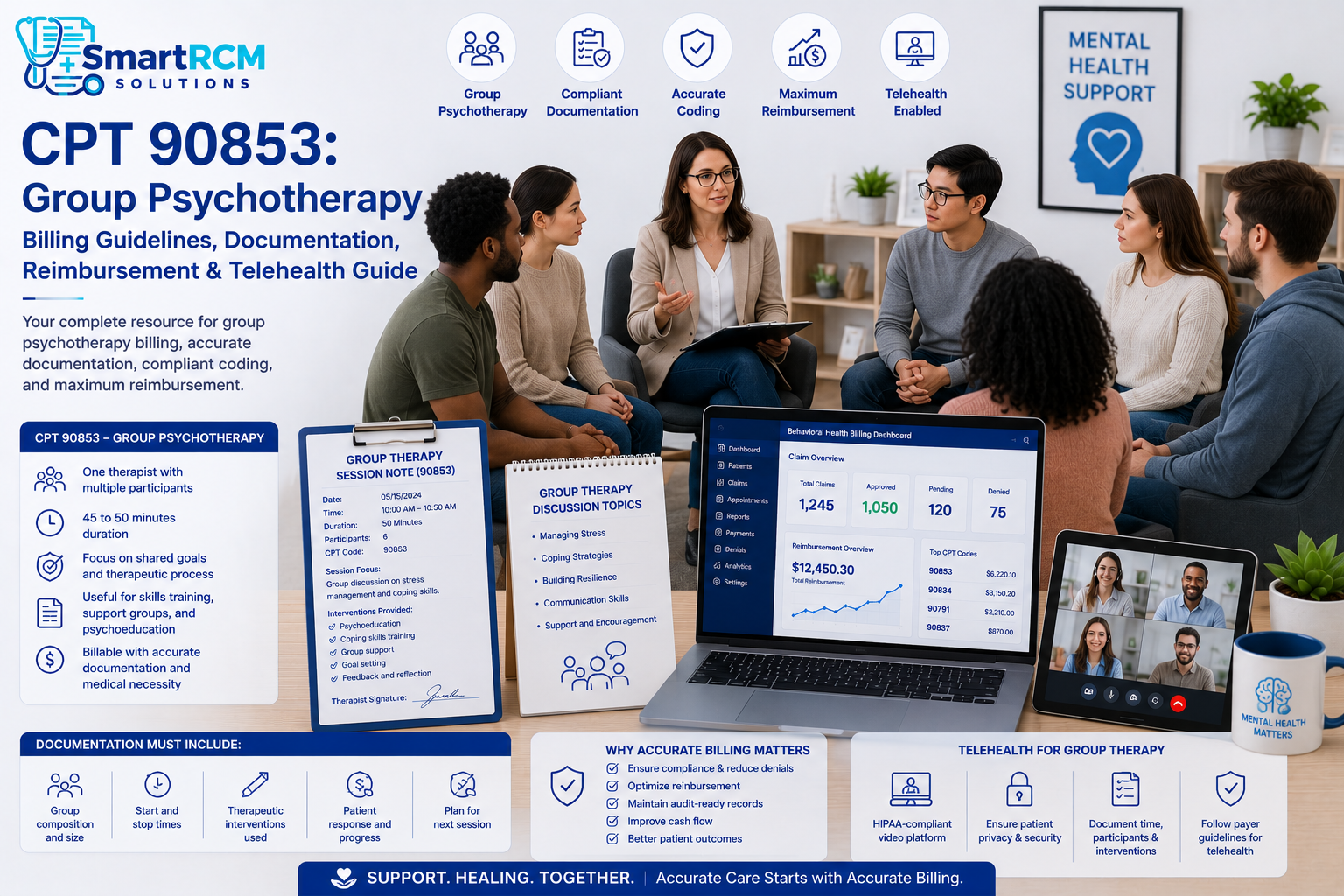
Group therapy plays an important role in behavioral health treatment. Many patients benefit from structured therapeutic sessions that allow them to share experiences, develop coping strategies, improve communication skills, and receive support from peers facing similar challenges. CPT 90853 allows qualified behavioral health professionals to report these group psychotherapy services.
Because group psychotherapy billing differs from individual psychotherapy and family therapy services, providers must understand the specific documentation requirements, reimbursement considerations, telehealth rules, and coding guidelines associated with CPT Code 90853.
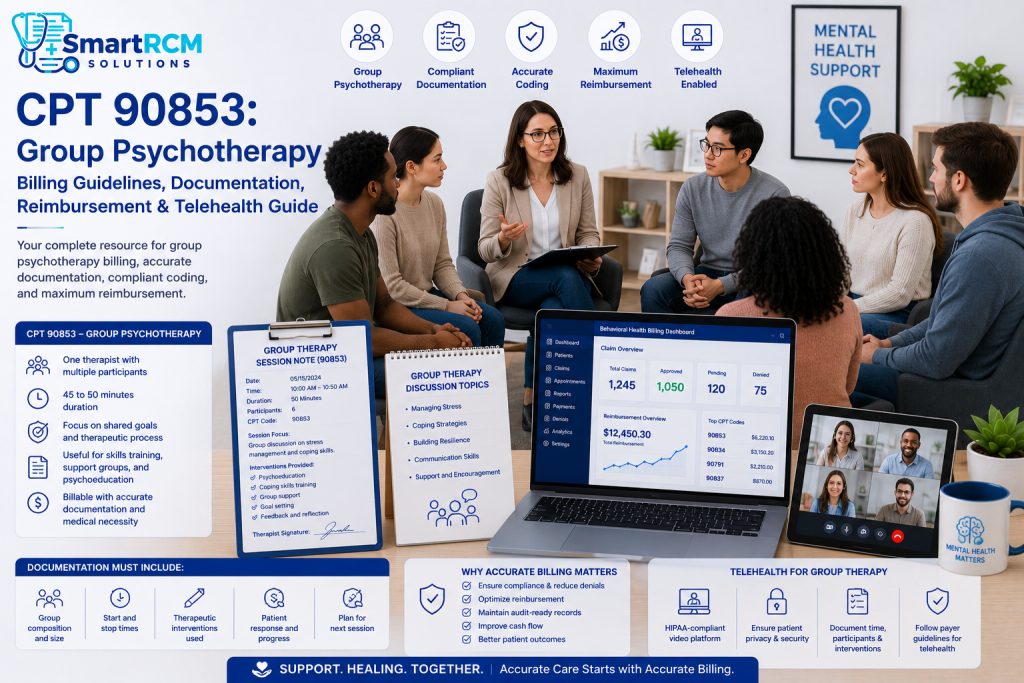
CPT 90853 – A Detailed Guide
This guide explains the CPT 90853 description, time considerations, documentation requirements, reimbursement information, telehealth billing rules, and common denial prevention strategies.
CPT 90853 Quick Answer
CPT 90853 describes group psychotherapy services provided to multiple patients in a therapeutic group setting. The service focuses on psychological treatment, emotional support, behavioral interventions, and therapeutic interaction among group participants.
CPT 90853 Description
Understanding the official CPT code description helps providers report services accurately.
CPT 90853 describes Group Psychotherapy.
Unlike individual psychotherapy services such as CPT 90832, CPT 90834, and CPT 90837, group psychotherapy involves treating multiple patients simultaneously in a structured therapeutic environment.
The provider facilitates discussion, therapeutic exercises, skill development, and behavioral interventions designed to support treatment goals.
CPT Code 90853 Description at a Glance
| Category | Details |
|---|---|
| CPT Code | 90853 |
| Description | Group Psychotherapy |
| Service Type | Behavioral Health Treatment |
| Setting | Group Therapy |
| Telehealth Eligible | Payer Dependent |
| Documentation Required | Yes |
| Specialty | Psychiatry & Behavioral Health |
CPT 90853 Time Requirement
One of the most common questions involves the 90853 time requirement.
Unlike 90832, 90834, and 90837, CPT 90853 is not defined by a specific psychotherapy time range.
However, group psychotherapy sessions commonly last between 45 and 60 minutes.
Documentation Best Practices
Providers should document:
- Session start time
- Session end time
- Total session duration
- Therapeutic interventions used
- Patient participation
Although the code itself is not strictly time-based, documenting session length supports medical necessity and audit readiness.
Who Can Bill CPT 90853?
Several qualified behavioral health professionals may report Group Psychotherapy CPT Code 90853.
Common provider types include:
- Psychiatrists
- Psychologists
- Licensed Clinical Social Workers (LCSWs)
- Licensed Professional Counselors (LPCs)
- Licensed Mental Health Counselors (LMHCs)
- Marriage and Family Therapists (where permitted)
- Other credentialed behavioral health providers
Provider eligibility varies by payer, state regulations, and credentialing requirements.
Therefore, providers should verify billing eligibility before submitting claims.
When Should Providers Use CPT Code 90853?
Providers report 90853 CPT Code when psychotherapy services are delivered to multiple patients simultaneously in a structured therapeutic group.
Common treatment settings include:
- Substance abuse recovery programs
- Anxiety management groups
- Depression support groups
- Trauma recovery groups
- Anger management programs
- Social skills training groups
- Behavioral health intensive outpatient programs (IOPs)
Additionally, group therapy often supports treatment goals by encouraging peer interaction and shared learning experiences.
Common Conditions Treated Through Group Psychotherapy
Behavioral health professionals frequently use Group Therapy Code 90853 to treat various mental health conditions.
Examples include:
Depression: Patients often benefit from peer support, shared coping strategies, and structured therapeutic discussions.
Anxiety Disorders: Group psychotherapy can help patients practice communication skills and reduce social isolation.
Substance Use Disorders: Many addiction treatment programs incorporate group therapy to support recovery and relapse prevention.
PTSD and Trauma: Trauma-focused therapy groups may provide emotional support and therapeutic skill-building opportunities.
Bipolar Disorder: Structured group sessions can improve treatment adherence and patient education.
Behavioral Disorders: Providers may use group therapy to improve social functioning and coping skills.
CPT 90853 Documentation Requirements
Accurate documentation remains critical for reimbursement and compliance.
Documentation should support medical necessity and clearly identify the services performed.
Patient Information
Include:
- Patient name
- Date of service
- Diagnosis
- Provider information
Group Session Details
Documentation should identify:
- Group topic
- Treatment goals
- Session structure
- Therapeutic interventions
Patient Participation
Providers should document:
- Level of participation
- Behavioral observations
- Response to treatment
- Progress toward goals
Therapeutic Interventions
Examples include:
- Cognitive Behavioral Therapy (CBT)
- Psychoeducation
- Coping skills training
- Relapse prevention
- Communication skill development
- Stress management techniques
Treatment Progress
Documentation should support:
- Clinical progress
- Treatment response
- Future recommendations
- Follow-up planning
Strong documentation helps reduce denial risk and supports reimbursement.
CPT 90853 vs CPT 90834 vs CPT 90837
Behavioral health providers frequently compare these psychotherapy codes.
| Feature | CPT 90853 | CPT 90834 | CPT 90837 |
|---|---|---|---|
| Group Therapy | Yes | No | No |
| Individual Therapy | No | Yes | Yes |
| Multiple Patients | Yes | No | No |
| Typical Duration | Group Session | 45 Minutes | 60 Minutes |
| Therapy Format | Group | Individual | Individual |
Understanding these differences helps providers select the correct code based on the service delivered.
CPT 90853 Reimbursement Information
Reimbursement for 90853 varies depending on several factors, including payer policies, provider credentials, geographic location, and contractual agreements.
Because group psychotherapy allows providers to treat multiple patients simultaneously, reimbursement is generally lower per patient than individual psychotherapy services such as CPT 90834 or CPT 90837. However, group therapy can still generate significant revenue when scheduled and documented appropriately.
Factors that affect reimbursement include:
- Insurance carrier
- Provider specialty
- State regulations
- Telehealth policies
- Contracted fee schedules
- Medical necessity requirements
Providers should always verify payer-specific reimbursement policies before submitting claims.
Telehealth Billing for CPT 90853
Behavioral health organizations increasingly offer group psychotherapy through secure telehealth platforms.
Many commercial payers, Medicaid programs, and certain Medicare plans allow virtual group therapy services. However, coverage requirements vary considerably.
Before billing telehealth group psychotherapy, providers should verify:
✓ Telehealth eligibility
✓ Group therapy coverage
✓ Provider requirements
✓ Documentation standards
✓ Modifier requirements
✓ Place of Service reporting rules
Because telehealth regulations continue to evolve, verification remains essential.
Modifier 95 for Group Psychotherapy
Modifier 95 is frequently required when CPT 90853 services are delivered through real-time audio and video communication technology.
Billing Example
| CPT Code | Modifier |
|---|---|
| 90853 | 95 |
Documentation should include:
- Patient consent
- Telehealth platform used
- Group session details
- Provider participation
- Session duration
- Therapeutic interventions performed
For additional guidance, providers should reference your Modifier 95 and Mental Health Modifiers articles.
POS 02 vs POS 10 for CPT 90853
Telehealth claims require the correct Place of Service code.
| POS Code | Description |
|---|---|
| POS 02 | Telehealth Provided Other Than Patient’s Home |
| POS 10 | Telehealth Provided in Patient’s Home |
POS 02
Report POS 02 when the patient participates from a location other than their residence.
POS 10
Report POS 10 when the patient receives telehealth services while located at home.
Incorrect POS reporting frequently causes reimbursement delays and claim denials.
Real Billing Examples for CPT 90853
Understanding real-world scenarios helps improve coding accuracy.
Example 1: Depression Support Group
A licensed clinical social worker conducts a weekly depression support group involving eight patients.
Treatment Focus
- Cognitive restructuring
- Coping strategies
- Peer support
- Emotional regulation
Billing
| Service | Code |
|---|---|
| Group Psychotherapy | CPT 90853 |
Because psychotherapy services were provided in a group setting, CPT 90853 appropriately reflects the service delivered.
Example 2: Substance Abuse Recovery Group
A behavioral health provider facilitates a recovery-focused group session for individuals receiving treatment for substance use disorders.
Session Activities
- Relapse prevention education
- Trigger identification
- Recovery planning
- Group discussion
Billing
| Service | Code |
|---|---|
| Group Psychotherapy | CPT 90853 |
The session qualifies for CPT 90853 because therapeutic interventions were delivered in a structured group environment.
Example 3: Telehealth Group Therapy Session
A psychologist conducts a virtual anxiety management group using a secure telehealth platform.
Billing Example
| Service | Code |
|---|---|
| Group Psychotherapy | CPT 90853 |
| Telehealth Modifier | 95 |
Documentation should support both the psychotherapy service and telehealth delivery requirements.
Common Billing Mistakes
Several coding errors contribute to preventable denials involving CPT 90853.
Insufficient Documentation
Providers sometimes document only attendance without describing:
- Therapeutic interventions
- Clinical goals
- Patient participation
- Treatment progress
As a result, claims may not support medical necessity.
Reporting Individual Therapy Codes Instead of CPT 90853
Some providers mistakenly bill:
- CPT 90832
- CPT 90834
- CPT 90837
when services were actually delivered in a group format.
Code selection should always reflect the service provided.
Telehealth Documentation Errors
Common telehealth mistakes include:
- Missing Modifier 95
- Incorrect POS code
- Missing consent documentation
- Incomplete virtual session records
These errors frequently result in payment delays.
Failure to Verify Coverage
Not all plans cover group psychotherapy equally.
Consequently, providers should verify:
- Benefits
- Authorization requirements
- Session limitations
- Telehealth coverage
before treatment begins.
Denial Prevention Strategies
Strong billing workflows significantly improve reimbursement outcomes.
Verify Eligibility Before Treatment
Confirm:
✓ Active coverage
✓ Behavioral health benefits
✓ Group therapy coverage
✓ Authorization requirements
✓ Telehealth eligibility
This step helps identify coverage issues before services are rendered.
Maintain Detailed Documentation
Documentation should support:
- Diagnosis
- Medical necessity
- Group topic
- Therapeutic interventions
- Patient participation
- Treatment response
- Progress toward goals
Comprehensive records strengthen reimbursement support.
Conduct Regular Audits
Routine audits help identify:
- Coding inconsistencies
- Missing documentation
- Telehealth compliance issues
- Reimbursement risks
As a result, organizations can improve coding accuracy and reduce future denials.
Train Providers and Staff
Behavioral health billing requirements continue to evolve.
Ongoing education helps providers and billing teams maintain compliance while improving claim acceptance rates.
Frequently Asked Questions
Q. What is CPT 90853?
A. CPT 90853 is a behavioral health code used to report group psychotherapy services provided to multiple patients in a structured therapeutic setting.
Q. What is the official CPT 90853 description?
A. The official CPT 90853 description is: Group Psychotherapy. Providers use this code when psychotherapy services are delivered to a group of patients rather than an individual patient.
Q. Is CPT 90853 a time-based code?
A. No. CPT 90853 is not assigned a specific psychotherapy time range like CPT 90832, CPT 90834, or CPT 90837. However, most group psychotherapy sessions typically last between 45 and 60 minutes, and providers should document session duration.
Q. Who can bill CPT Code 90853?
A. Qualified behavioral health professionals may bill CPT 90853, including: Psychiatrists, Psychologists, Psychiatrists, Psychologists, Licensed Clinical Social Workers (LCSWs), Licensed Professional Counselors (LPCs), Licensed Mental Health Counselors (LMHCs), and Marriage and Family Therapists (where permitted). Provider eligibility depends on payer requirements, state regulations, and credentialing status.
Q. Can CPT 90853 be billed through telehealth?
A. Yes. Many insurance carriers allow telehealth billing for CPT 90853 when providers meet payer-specific telehealth requirements and documentation standards.
Q. Does CPT 90853 require Modifier 95?
A. Many telehealth group psychotherapy claims require Modifier 95 to indicate that services were provided through real-time audio and video communication technology. Providers should always verify payer-specific guidelines before billing.
Q. Can CPT 90853 be billed with individual psychotherapy codes?
A. Generally, CPT 90853 is reported for group psychotherapy services, while CPT 90832, CPT 90834, and CPT 90837 are used for individual psychotherapy. When multiple services occur on the same date, documentation must clearly support separate and distinct medically necessary services.
Conclusion
CPT 90853 is an important behavioral health billing code that supports psychotherapy services delivered in a structured group setting. Group therapy provides patients with valuable peer support, skill development opportunities, and therapeutic interventions that complement individual treatment plans.
Furthermore, understanding CPT 90853 billing requirements helps providers improve reimbursement accuracy while maintaining compliance. Proper documentation should clearly support medical necessity, patient participation, treatment goals, and therapeutic interventions.
Because group psychotherapy continues to play a significant role in behavioral health treatment, providers should establish strong billing workflows, verify payer requirements, and conduct regular documentation audits to reduce denials and improve claim acceptance rates.