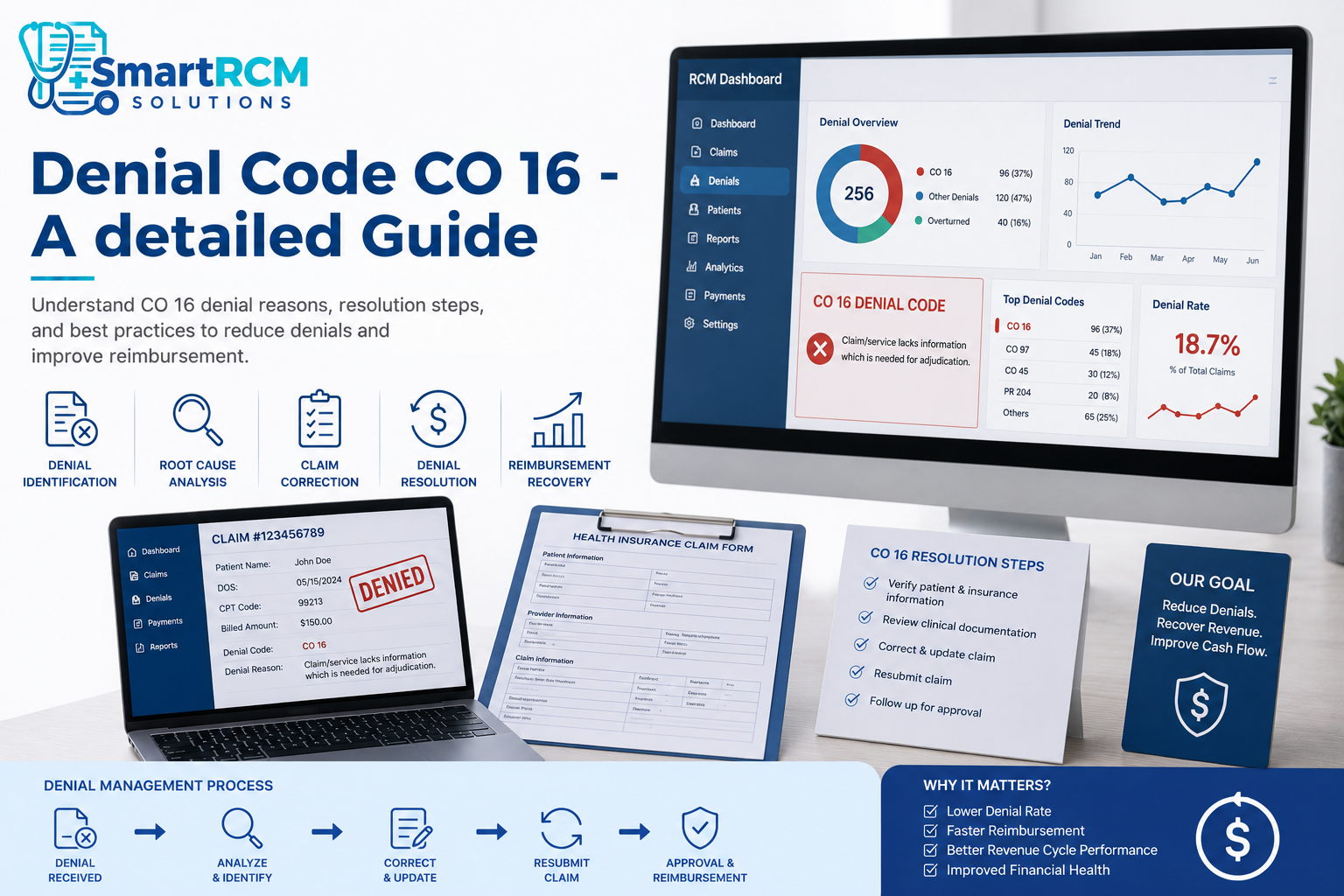
Claim denials continue to be one of the biggest challenges in medical billing and revenue cycle management. Among the most common denial codes, CO 16 Denial Code frequently causes reimbursement delays because the submitted claim lacks required information needed for processing.
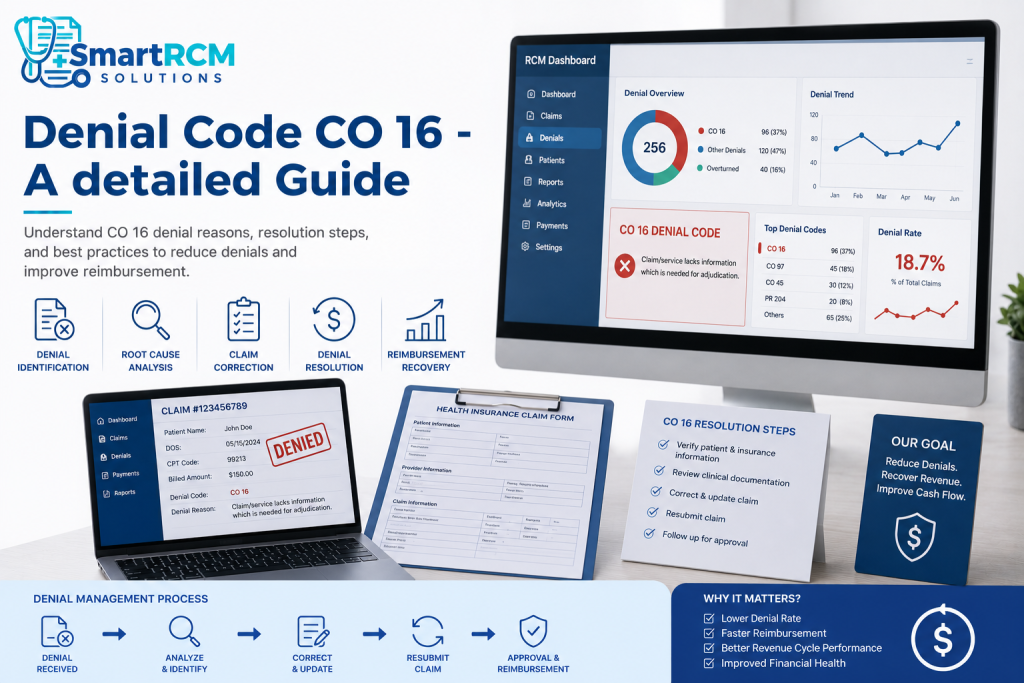
CO 16 Denial Code -A Detailed Guide
Although this denial may seem simple, unresolved CO 16 denials can significantly increase accounts receivable days, create administrative burdens, and negatively impact cash flow. Therefore, billing teams must understand why this denial occurs and how to correct it quickly.
This guide explains the meaning of CO 16 Denial Code, common causes, correction strategies, appeal processes, examples, and prevention techniques to help healthcare organizations improve first-pass claim acceptance rates.
CO 16 Denial Code
CO 16 Denial Code means the claim lacks information that is needed for adjudication. The payer cannot process the claim because required information is missing, incomplete, invalid, or inconsistent. Providers must review associated remark codes, identify the missing information, correct the claim, and resubmit it for processing.
What Is CO 16 Denial Code?
CO 16 is one of the most frequently encountered Claim Adjustment Reason Codes (CARCs) in medical billing.
The official description of CO 16 states:
“Claim/service lacks information which is needed for adjudication.”
In simple terms, the insurance payer cannot determine payment eligibility because essential claim information is missing or invalid.
As a result, the claim remains unprocessed until the missing information is corrected.
What Does Claim Adjustment Reason Code 16 Mean?
Claim Adjustment Reason Code 16 indicates that the payer requires additional information before making a payment decision.
Unlike medical necessity denials or coverage denials, CO 16 generally does not mean the service is non-covered.
Instead, the payer needs additional details to complete claim adjudication.
Consequently, providers can often resolve this denial relatively quickly once they identify the missing information.
Read More: CO 45 Denial Code
Why CO 16 Denials Matter
Many organizations underestimate the financial impact of CO 16 denials.
However, repeated occurrences can lead to:
- Delayed reimbursement
- Increased administrative costs
- Higher denial rates
- Extended A/R days
- Additional staff workload
- Reduced cash flow
- Revenue leakage
Therefore, reducing CO 16 denials should be a priority for every healthcare organization.
Common Causes of CO 16 Denial Code
Several claim errors can trigger a CO 16 denial.
Understanding these causes helps billing teams improve claim accuracy and prevent future denials.
Missing Patient Information
Patient demographic errors remain one of the most common causes of CO 16 denials.
Examples include:
- Missing patient name
- Missing date of birth
- Missing gender
- Incomplete address
- Incorrect member ID
Even minor registration errors can cause claim rejection.
Invalid Insurance Information
Insurance information must match payer records exactly.
Common issues include:
- Incorrect policy number
- Missing subscriber ID
- Invalid group number
- Coverage termination
- Incorrect insurance plan selection
Consequently, eligibility verification remains essential.
Missing Authorization Information
Many services require prior authorization before treatment.
Claims may receive a CO 16 denial when:
- Authorization numbers are missing
- Authorization data is incomplete
- Authorization information does not match the claim
This issue frequently occurs with specialty services, imaging procedures, and behavioral health treatments.
Missing Referring Provider Information
Certain services require referring provider details.
Missing information may include:
- Referring provider name
- NPI number
- Referral documentation
- Provider credentials
Without this information, the payer may suspend claim processing.
Missing NPI Information
National Provider Identifier (NPI) errors frequently trigger claim denials.
Common examples include:
- Missing rendering provider NPI
- Missing billing provider NPI
- Invalid NPI
- Incorrect provider identifiers
Providers should verify NPI accuracy before submission.
Missing Modifiers
Procedure modifiers communicate important information about services performed.
Claims may receive a CO 16 denial when:
- Required modifiers are missing
- Incorrect modifiers are used
- Telehealth modifiers are omitted
- Multiple procedure modifiers are incomplete
Modifier-related denials continue to increase as payer requirements evolve.
Missing Diagnosis Information
Diagnosis coding issues can prevent proper adjudication.
Examples include:
- Missing ICD-10 code
- Invalid diagnosis code
- Incomplete diagnosis reporting
- Diagnosis-procedure mismatch
Accurate diagnosis coding supports medical necessity and claim processing.
Incomplete Claim Submission
Sometimes the denial results from general claim incompleteness.
Missing data may include:
- Date of service
- Provider information
- Procedure codes
- Units billed
- Place of service
- Taxonomy information
Comprehensive claim scrubbing helps identify these issues before submission.
Industries Most Affected by CO 16 Denials
Although CO 16 can affect any specialty, certain sectors experience these denials more frequently.
These specialties include:
- Mental Health Billing
- Psychiatry Billing
- Physical Therapy Billing
- Chiropractic Billing
- Cardiology Billing
- Radiology Billing
- Home Health Billing
- Durable Medical Equipment Billing
Because these specialties often require authorizations, referrals, and detailed documentation, claim completeness becomes even more important.
Warning Signs That Increase CO 16 Denials
Healthcare organizations may face elevated denial rates when they experience:
- Poor front-desk registration processes
- Weak eligibility verification workflows
- Lack of authorization tracking
- Inconsistent claim audits
- Insufficient staff training
- Manual data entry errors
Identifying these operational weaknesses can significantly improve denial performance.
Review Associated RARC Codes
CO 16 usually appears with one or more Remittance Advice Remark Codes (RARCs). These remark codes identify the exact information missing from the claim.
Without reviewing the RARC, providers may correct the wrong issue and receive another denial.
Common RARCs associated with CO 16 include:
| RARC Code | Description |
|---|---|
| MA130 | Claim lacks necessary information for processing |
| N382 | Missing or incomplete information |
| M51 | Missing, incomplete, or invalid procedure code information |
| N286 | Missing referral information |
| N290 | Missing provider information |
These remark codes help billing teams identify the root cause faster.
Identify Missing Information
After reviewing the denial and associated RARC codes, determine exactly what information is missing.
Common areas to investigate include:
Patient Demographics
Verify:
- Patient name
- Date of birth
- Address
- Gender
- Subscriber ID
Insurance Information
Verify:
- Policy number
- Group number
- Effective dates
- Insurance plan selection
Provider Information
Verify:
- Rendering provider NPI
- Billing provider NPI
- Referring provider information
- Taxonomy codes
Authorization Data
Verify:
- Authorization number
- Authorization dates
- Approved services
- Referral documentation
Coding Information
Verify:
- CPT codes
- ICD-10 codes
- HCPCS codes
- Modifiers
- Units billed
Correct the Claim
Once the missing information is identified, update the claim accordingly.
Before resubmission:
✓ Verify all corrected information
✓ Confirm documentation supports services
✓ Validate authorization requirements
✓ Review coding accuracy
✓ Check payer-specific billing guidelines
Organizations that implement quality control reviews often reduce repeat denials.
Resubmit the Claim
After correcting the claim:
- Follow payer resubmission guidelines
- Include supporting documentation when required
- Attach corrected authorization information
- Submit within timely filing limits
Prompt resubmission helps minimize payment delays.
Track Claim Status
After resubmitting the claim:
- Monitor payer responses
- Verify claim acceptance
- Track reimbursement status
- Follow up when necessary
Active claim monitoring improves denial recovery performance.
CO 16 Denial Code and RARC Codes
Understanding associated remark codes is essential because CO 16 only indicates that information is missing.
The RARC provides the specific details needed to resolve the denial.
MA130
Your claim contains missing or incomplete information.
Common Causes
- Missing demographics
- Missing provider information
- Incomplete authorization details
Resolution
Review claim completeness and resubmit corrected information.
N382
The claim requires additional information before processing.
Common Causes
- Missing supporting documentation
- Incomplete claim fields
- Invalid data elements
Resolution
Identify missing documentation and submit corrections.
M51
Procedure code information is missing, incomplete, or invalid.
Common Causes
- Incorrect CPT codes
- Missing modifiers
- Coding inconsistencies
Resolution
Review coding accuracy and resubmit corrected claims.
N286
Referral information is missing or incomplete.
Common Causes
- Missing referral number
- Missing referring provider information
- Incomplete referral documentation
Resolution
Obtain referral information and update the claim.
N290
Provider information is missing or incomplete.
Common Causes
- Missing NPI
- Invalid provider identifiers
- Credentialing mismatches
Resolution
Verify provider enrollment and correct identifiers.
CO 16 Denial Code Appeal Process
Not every CO 16 denial requires an appeal.
In many cases, providers simply correct the claim and resubmit it.
However, appeals may become necessary when:
- Required information was already submitted
- The payer processed the claim incorrectly
- Documentation supports the original submission
- The denial was issued in error
When Should Providers Appeal?
Providers should consider appealing when:
✓ The claim was complete at submission
✓ Authorization requirements were met
✓ Supporting documentation exists
✓ Payer records appear inaccurate
Documents Needed for an Appeal
Depending on the denial reason, providers may need:
- Medical records
- Authorization documentation
- Referral documentation
- Eligibility verification records
- Corrected claim forms
- Provider credential information
Strong supporting documentation improves appeal success rates.
Appeal Letter Best Practices
Effective appeal letters should:
- Clearly explain the denial issue
- Reference claim numbers
- Include supporting evidence
- Request claim reconsideration
- Maintain professional language
Well-organized appeals often receive faster review.
Common CO 16 Denial Recovery Mistakes
Many organizations unintentionally delay reimbursement by making avoidable mistakes.
Common errors include:
❌ Ignoring associated RARC codes
❌ Resubmitting claims without correction
❌ Missing timely filing deadlines
❌ Failing to document correction efforts
❌ Submitting incomplete appeals
❌ Overlooking authorization requirements
Preventing these mistakes can significantly improve recovery rates.
How to Prevent CO 16 Denials
Preventing CO 16 denials is significantly more cost-effective than correcting and resubmitting denied claims. Healthcare organizations that implement proactive denial prevention strategies often improve first-pass claim acceptance rates and reduce accounts receivable days.
Because most CO 16 denials result from missing or incomplete information, strong front-end and back-end workflows can dramatically reduce denial volumes.
Front Desk Best Practices
The denial prevention process begins before the patient receives services.
Front-desk staff play a critical role in collecting accurate information and preventing claim errors.
Verify Patient Demographics
Before each visit, confirm:
✓ Patient name
✓ Date of birth
✓ Address
✓ Phone number
✓ Insurance information
Even small registration errors can trigger claim denials.
Collect Updated Insurance Information
Patients frequently change insurance plans.
Therefore, staff should:
- Request current insurance cards
- Verify policy information
- Confirm subscriber details
- Update records immediately
Accurate insurance data reduces claim submission errors.
Verify Referrals and Authorizations
When referrals or authorizations are required:
✓ Obtain authorization numbers
✓ Verify approval dates
✓ Confirm covered services
✓ Document authorization details
This process helps prevent authorization-related CO 16 denials.
Eligibility Verification Workflow
Eligibility verification remains one of the most effective denial prevention strategies.
Organizations should verify eligibility before every appointment.
Eligibility Checklist
Confirm:
- Active coverage
- Policy effective dates
- Copay requirements
- Deductible status
- Referral requirements
- Authorization requirements
- Network participation
Consistent verification significantly reduces payer-related denials.
Authorization Management Process
Authorization failures remain a leading cause of CO 16 denials.
Consequently, organizations should maintain a structured authorization workflow.
Authorization Best Practices
Before services are rendered:
✓ Confirm authorization requirements
✓ Obtain approvals
✓ Document authorization numbers
✓ Track expiration dates
✓ Verify approved services
Strong authorization controls help protect reimbursement.
Claim Scrubbing Best Practices
Claim scrubbing software helps identify missing information before claim submission.
Organizations should review claims for:
- Missing demographics
- Missing modifiers
- Invalid diagnosis codes
- Incorrect CPT codes
- Missing provider information
- Authorization errors
- NPI issues
Automated claim reviews often reduce denial rates significantly.
Financial Impact of CO 16 Denials
Many healthcare organizations underestimate the cost of denial management.
However, recurring CO 16 denials can create substantial financial burdens.
Revenue Delays
Every denied claim delays reimbursement.
Consequently, organizations experience:
- Slower cash flow
- Increased A/R days
- Administrative expenses
- Staff productivity losses
Increased Labor Costs
Each denied claim requires:
- Investigation
- Correction
- Resubmission
- Follow-up
Repeated denials increase operational expenses and reduce efficiency.
Lost Revenue Opportunities
Organizations focusing on denial recovery often divert resources away from:
- Patient care
- Process improvement
- Revenue growth initiatives
Reducing preventable denials improves overall financial performance.
Revenue Cycle Optimization Tips
Healthcare organizations can improve claim performance by strengthening revenue cycle processes.
Standardize Registration Procedures
Create registration checklists that ensure complete data collection.
Standardized workflows reduce variability and improve accuracy.
Train Staff Regularly
Ongoing education helps employees stay current with:
- Payer requirements
- Coding updates
- Authorization rules
- Documentation standards
Well-trained teams generate fewer claim errors.
Monitor Denial Trends
Organizations should track:
- Denial rates
- Denial categories
- Payer-specific issues
- Root causes
Data-driven analysis helps identify improvement opportunities.
Conduct Internal Audits
Regular audits help identify workflow weaknesses before claims reach payers.
As a result, organizations can correct issues proactively.
CO 16 Denial Prevention Checklist
Before claim submission, verify:
✓ Patient demographics are complete
✓ Insurance information is accurate
✓ Eligibility has been verified
✓ Authorization requirements have been met
✓ Referral requirements have been met
✓ Provider information is complete
✓ NPI numbers are accurate
✓ CPT codes are correct
✓ ICD-10 codes support services
✓ Required modifiers are present
✓ Documentation supports medical necessity
✓ Claim has passed claim-scrubbing review
Organizations that consistently follow this checklist often achieve stronger claim acceptance rates.
Frequently Asked Questions
Q. What is CO 16 Denial Code?
A. CO 16 Denial Code indicates that a claim lacks information needed for adjudication.
Q. What does Claim Adjustment Reason Code 16 mean?
A. CARC 16 means the payer requires additional information before processing the claim.
Q. Why did my claim receive a CO 16 denial?
A. Common causes include missing patient information, missing authorization numbers, incomplete provider information, missing modifiers, and coding errors.
Q. How do I fix a CO 16 denial?
A. Review the denial details, identify missing information, correct the claim, and resubmit it according to payer guidelines.
Q. Is CO 16 Denial Code appealable?
A. Yes. Providers may appeal when they believe the denial was issued incorrectly or when supporting documentation proves the claim was complete.
Q. What remark codes are commonly associated with CO 16?
A. Common RARC codes include MA130, N382, M51, N286, and N290.
Q. What is the most common cause of CO 16 denials?
A. Missing or incomplete claim information is the most frequent cause.
Q. Can missing authorizations cause a CO 16 denial?
A. Yes. Missing authorization numbers frequently trigger CO 16 denials.
Q. Can missing modifiers cause CO 16 denials?
A. Yes. Required modifiers that are omitted from claims may result in denial.
Q. Does CO 16 mean the service is not covered?
A. No. CO 16 generally indicates missing information rather than a coverage issue.
Q. How can providers prevent CO 16 denials?
A. Providers can reduce denials through eligibility verification, authorization management, claim scrubbing, and staff training.
Q. What is the difference between CO 16 and CO 197?
A. CO 16 generally involves missing information, while CO 197 often relates to authorization requirements.
Q. Can incorrect patient demographics trigger CO 16?
A. Yes. Registration errors frequently cause claim adjudication problems.
Q. How long does it take to resolve a CO 16 denial?
A. Resolution times vary depending on payer requirements and how quickly corrections are submitted.
Q. Why should providers monitor CO 16 denial trends?
A. Tracking denial patterns helps organizations identify workflow weaknesses and improve revenue cycle performance.
Conclusion
CO 16 Denial Code is one of the most common claim adjustment reason codes in medical billing. It indicates that the payer cannot process a claim because required information is missing, incomplete, invalid, or inconsistent. Although the denial is often preventable, it can significantly impact reimbursement timelines, increase administrative workload, and reduce cash flow.
Furthermore, healthcare organizations can reduce CO 16 denials by strengthening patient registration processes, verifying eligibility before services are rendered, obtaining authorizations when required, and implementing comprehensive claim-scrubbing procedures. Accurate documentation, staff training, and ongoing denial monitoring also play a critical role in denial prevention.
Ultimately, organizations that focus on proactive revenue cycle management and claim accuracy are better positioned to minimize CO 16 denials, accelerate reimbursement, improve operational efficiency, and maximize financial performance.