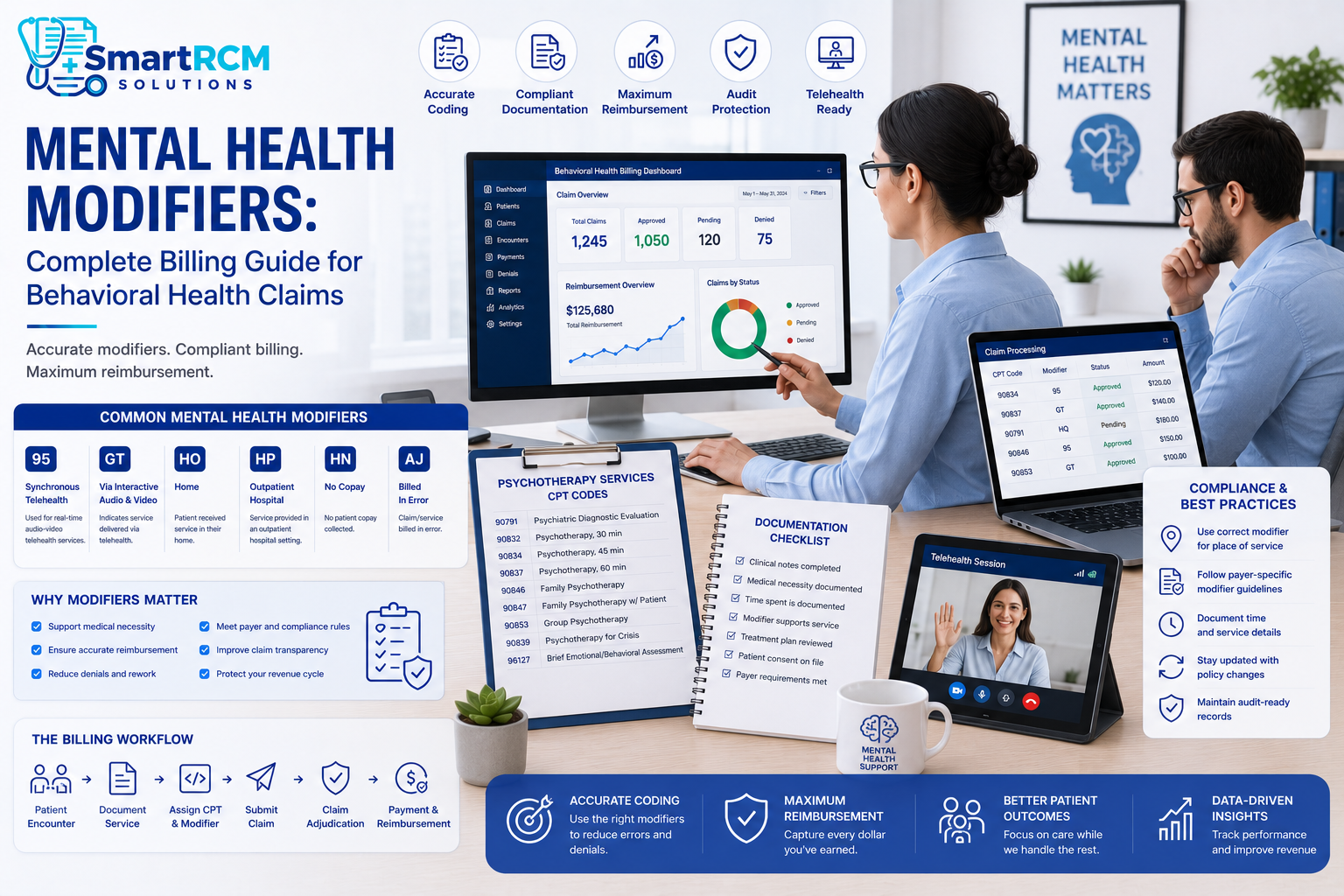
Mental health modifiers play a critical role in behavioral health billing. Providers use these modifiers to communicate additional information about the services performed, the provider’s credentials, the treatment setting, and the method of service delivery.
Because insurance carriers rely on modifiers to process claims accurately, incorrect modifier usage can result in claim denials, reimbursement delays, compliance concerns, and payer audits.
Behavioral health organizations that understand modifier requirements can improve coding accuracy, reduce billing errors, and strengthen revenue cycle performance.
Mental Health Modifiers
This guide explains the most commonly used mental health modifiers, telehealth billing requirements, documentation expectations, and denial prevention strategies.
Mental Health Modifiers Quick Answer
Mental health modifiers are two-character billing codes appended to CPT and HCPCS codes to provide additional information about a behavioral health service. Common mental health modifiers include Modifier 95, HO, HN, HM, HP, GT, AJ, and U modifiers used by Medicaid programs and commercial insurance carriers.
What Are Mental Health Modifiers?
Mental health modifiers help payers identify:
- Provider credentials
- Telehealth services
- Treatment settings
- Supervision requirements
- Program participation
- State-specific billing requirements
These modifiers do not replace CPT codes.
Instead, they provide additional information that helps insurance companies process claims correctly.
Why Mental Health Modifiers Matter
Proper modifier usage helps providers:
- Improve claim acceptance rates
- Reduce denials
- Support reimbursement accuracy
- Meet payer requirements
- Improve billing compliance
Furthermore, many payers require specific modifiers for behavioral health services.
Failure to report them correctly can result in rejected or denied claims.
Common Mental Health Modifiers
Several modifiers appear frequently in behavioral health billing.
Modifier 95
Modifier 95 Description
The Modifier 95 indicates that a service was provided through real-time interactive audio and video telecommunications technology.
This is one of the most commonly used modifiers in modern behavioral health billing.
Common Uses
Modifier 95 frequently applies to:
- CPT 90791
- CPT 90792
- CPT 90832
- CPT 90834
- CPT 90837
- CPT 90847
Documentation Requirements
Providers should document:
- Patient consent
- Telehealth technology used
- Session duration
- Clinical services performed
Because telehealth billing requirements vary among payers, providers should verify specific billing rules before claim submission.
Modifier HO
HO Modifier Description
Modifier HO identifies services provided by a professional with a master’s degree level qualification.
Many Medicaid programs use this modifier to identify provider credentials.
Common Providers
- Licensed Professional Counselors
- Licensed Mental Health Counselors
- Master’s-level therapists
Why HO Matters
Some payers use provider-level modifiers to determine reimbursement eligibility.
As a result, missing modifiers may affect payment processing.
Modifier HN
HN Modifier Description
Modifier HN identifies services provided by a bachelor’s degree-level professional.
Certain Medicaid programs require this modifier when applicable.
Common Uses
- Behavioral health programs
- Community mental health services
- State Medicaid programs
Providers should review state-specific billing requirements because modifier usage varies significantly.
Modifier HM
HM Modifier Description
Modifier HM indicates that the service was provided by a professional under a less-than-master’s level qualification.
This modifier appears primarily in Medicaid and community behavioral health programs.
Common Applications
- Community support services
- Behavioral health programs
- State-funded mental health initiatives
Modifier HP
HP Modifier Description
Modifier HP identifies services provided by a doctoral-level provider.
Common Providers
- Psychologists
- Doctoral-level clinicians
- Certain behavioral health specialists
Some payers use HP to distinguish provider credentials during claim adjudication.
Mental Health Modifier Comparison Table
| Modifier | Description |
|---|---|
| 95 | Telehealth Service |
| HO | Master’s Level Provider |
| HN | Bachelor’s Level Provider |
| HM | Less Than Master’s Level Provider |
| HP | Doctoral-Level Provider |
Understanding these distinctions helps providers improve claim accuracy and avoid billing mistakes.
Documentation Requirements for Mental Health Modifiers
Whenever modifiers are reported, documentation should support:
- Provider credentials
- Medical necessity
- Telehealth requirements
- Treatment services performed
- Applicable payer rules
Strong documentation reduces compliance risks and supports reimbursement.
Modifier GT
Although Modifier 95 has become the most commonly used telehealth modifier, some insurance carriers still recognize or require Modifier GT.
GT Modifier Description
Modifier GT indicates that a service was delivered through interactive audio and video telecommunications technology.
Historically, many payers used GT before adopting Modifier 95.
Common Uses
Providers may encounter Modifier GT when billing:
- Psychiatric evaluations
- Psychotherapy sessions
- Behavioral health follow-up visits
- Telepsychiatry services
Because payer requirements differ, providers should verify whether Modifier 95, Modifier GT, or another telehealth indicator is required before claim submission.
Modifier AJ
AJ Modifier Description
Modifier AJ identifies services provided by a clinical social worker.
Many state Medicaid programs and behavioral health plans use AJ to identify provider credentials during claims processing.
Common Uses
Modifier AJ may apply to:
- Individual psychotherapy
- Family therapy
- Behavioral health counseling
- Community mental health services
Documentation Requirements
Documentation should support:
- Provider credentials
- Service rendered
- Medical necessity
- Treatment goals
When required by the payer, omitting Modifier AJ may delay reimbursement or trigger claim rejections.
Common Medicaid U Modifiers
Many state Medicaid programs use U modifiers to identify specific behavioral health services.
Unlike nationally standardized modifiers, these codes vary by state and payer.
Examples of U Modifiers
| Modifier | Common Purpose* |
|---|---|
| U1 | State-Specific Service Indicator |
| U2 | Enhanced Service Level |
| U3 | Program-Specific Service |
| U4 | Specialized Treatment Service |
| U5–U9 | State-Defined Behavioral Health Services |
*Definitions vary by Medicaid program.
Because these modifiers are state-specific, providers should always review current Medicaid billing manuals before reporting them.
Telehealth Modifier Comparison
Telehealth billing remains one of the most common areas of confusion in behavioral health coding.
The table below summarizes common telehealth modifiers.
| Modifier | Purpose |
|---|---|
| 95 | Synchronous audio-video telehealth service |
| GT | Interactive telecommunication service |
| GQ | Store-and-forward telecommunication (payer-specific) |
| FQ | Audio-only telehealth (payer-specific) |
Most behavioral health providers primarily use Modifier 95 today. However, payer verification remains essential.
POS 02 vs POS 10 for Mental Health Billing
Telehealth claims require not only the correct modifier but also the appropriate Place of Service (POS) code.
| POS Code | Description |
|---|---|
| POS 02 | Telehealth Provided Other Than Patient’s Home |
| POS 10 | Telehealth Provided in Patient’s Home |
POS 02
Use POS 02 when the patient receives telehealth services from a location that is not their home.
POS 10
Use POS 10 when the patient receives telehealth services while located at home.
Incorrect POS selection can create payment delays, denials, or reimbursement discrepancies.
Therefore, providers should verify payer-specific guidance before billing.
Reimbursement Impact of Mental Health Modifiers
Modifiers can significantly influence reimbursement outcomes.
Insurance carriers often use modifiers to:
- Validate provider eligibility
- Determine telehealth reimbursement
- Identify provider credentials
- Apply payer-specific payment rules
For example, a missing telehealth modifier may result in claim denial even when the CPT code itself is correct.
Similarly, credentialing modifiers such as HO, HP, HN, or AJ may affect claims processing for Medicaid and behavioral health programs.
Because reimbursement policies vary among payers, practices should routinely review modifier requirements.
Real Billing Examples
Understanding modifier usage through practical examples can improve billing accuracy.
Telehealth Psychotherapy Session
| Field | Value |
|---|---|
| CPT Code | 90834 |
| Modifier | 95 |
| POS | 10 |
| Service | Telehealth Psychotherapy |
A licensed therapist conducts a 45-minute psychotherapy session through a secure audio-video platform while the patient participates from home.
The claim may be reported using CPT 90834 with Modifier 95 and POS 10 when supported by payer requirements.
Clinical Social Worker Service
| Field | Value |
|---|---|
| CPT Code | 90832 |
| Modifier | AJ |
| Provider Type | Clinical Social Worker |
When required by the payer, Modifier AJ identifies the provider as a clinical social worker.
Master’s-Level Therapist
| Field | Value |
|---|---|
| CPT Code | 90837 |
| Modifier | HO |
| Provider Type | Master’s-Level Clinician |
Certain Medicaid programs may require Modifier HO to identify provider credentials.
Common Mental Health Modifier Mistakes
Behavioral health organizations frequently encounter preventable modifier-related errors.
Missing Modifier 95
One of the most common mistakes involves failing to append Modifier 95 to telehealth services when required.
This issue often results in claim denials.
Incorrect Credentialing Modifiers
Providers sometimes report HO, HP, HN, or AJ incorrectly.
Credentialing modifiers should accurately reflect the provider rendering the service.
Using Outdated Modifier Rules
Telehealth regulations continue to evolve.
As a result, practices should avoid relying on outdated payer policies.
Incorrect POS Reporting
A correct modifier paired with the wrong POS code can still lead to reimbursement issues.
Providers should always review telehealth billing requirements before claim submission.
Denial Prevention Strategies
Strong billing processes help reduce modifier-related denials.
Verify Payer Requirements
Before submitting claims:
✓ Confirm modifier requirements
✓ Verify telehealth policies
✓ Review credentialing rules
✓ Check Medicaid billing manuals
Because requirements vary among payers, verification should occur regularly.
Maintain Detailed Documentation
Documentation should support:
- Service performed
- Provider credentials
- Medical necessity
- Telehealth technology used
- Session duration when applicable
Complete documentation strengthens audit readiness and supports reimbursement.
Conduct Routine Billing Audits
Regular claim reviews help identify:
- Modifier errors
- Documentation deficiencies
- Compliance risks
- Reimbursement opportunities
Consequently, organizations can correct issues before they become recurring problems.
Educate Providers and Billing Teams
Behavioral health billing rules change frequently.
Ongoing education helps providers and staff remain compliant while improving coding accuracy.
Additionally, organizations should connect modifier-related content with:
- Mental Health CPT Codes
- Psychiatry CPT Codes
- CPT 90791
- CPT 90792
- CPT 90832
- CPT 90834
- CPT 90837
- Modifier 95
These internal links strengthen behavioral health topical authority and improve website navigation.
Frequently Asked Questions
Q. What are Mental Health Modifiers?
A. Mental Health Modifiers are two-character codes appended to CPT or HCPCS codes to provide additional information about behavioral health services, provider credentials, telehealth delivery, and payer-specific billing requirements.
Q. Which modifier is most commonly used for telehealth mental health services?
A. Modifier 95 is currently the most commonly used telehealth modifier for behavioral health services. It indicates that the service was provided through real-time audio and video telecommunications technology.
Q. What is the difference between Modifier 95 and Modifier GT?
A. Both modifiers indicate telehealth services. However, Modifier 95 is more commonly used by commercial payers and Medicare, while some plans and legacy systems may still require Modifier GT. Providers should always verify payer-specific requirements.
Q. What does Modifier HO mean in mental health billing?
A. Modifier HO identifies services provided by a master’s-level behavioral health professional. Many Medicaid programs use this modifier to identify provider credentials during claims processing.
Q. What does Modifier HP mean?
A. Modifier HP indicates that services were provided by a doctoral-level professional, such as a psychologist or other qualified doctoral-level behavioral health provider.
Q. What is Modifier AJ used for?
A. Modifier AJ is commonly used to identify services rendered by a clinical social worker. Requirements vary by payer and Medicaid program.
Q. Do all mental health claims require modifiers?
A. No. Modifier requirements depend on the payer, service type, provider credentials, and delivery method. Some claims may require multiple billing indicators, while others may not require any modifier.
Q. Can incorrect modifiers cause claim denials?
A. Yes. Missing or incorrect modifiers are among the most common causes of behavioral health claim denials. Modifier errors may result in rejections, payment delays, or requests for additional documentation.
Q. What documentation is required when billing mental health modifiers?
A. Documentation should support:
- Medical necessity
- Provider credentials
- Services performed
- Telehealth delivery when applicable
- Session duration for time-based services
- Treatment goals and patient progress
Q. Which mental health CPT codes commonly use modifiers?
A. Common behavioral health services that may require modifiers include:
- CPT 90791
- CPT 90792
- CPT 90832
- CPT 90834
- CPT 90837
- CPT 90846
- CPT 90847
- CPT 90853
- CPT 90839
- CPT 96127
Modifier requirements vary based on payer policies.
Conclusion
Mental Health Modifiers play an essential role in behavioral health billing by providing payers with additional information about telehealth services, provider qualifications, treatment settings, and reimbursement requirements. Proper modifier selection helps improve claim accuracy, supports compliance, and reduces preventable denials.
Furthermore, understanding modifiers such as Modifier 95, HO, HN, HM, HP, GT, and AJ enables providers to navigate complex payer requirements more effectively. Because behavioral health billing rules continue to evolve, organizations should regularly review payer policies, update billing workflows, and train staff on modifier usage.
Accurate documentation remains equally important. Providers should ensure that every claim supports medical necessity, service details, provider credentials, and telehealth requirements when applicable. Strong documentation and proper modifier usage work together to improve reimbursement outcomes and strengthen audit readiness.
For organizations seeking to build expertise in behavioral health billing, Mental Health Modifiers should be understood alongside related topics such as Mental Health CPT Codes, Psychiatry CPT Codes, CPT 90791, CPT 90792, CPT 90832, CPT 90834, CPT 90837, and Modifier 95. Together, these resources create a comprehensive mental health billing knowledge base that supports both providers and revenue cycle professionals.