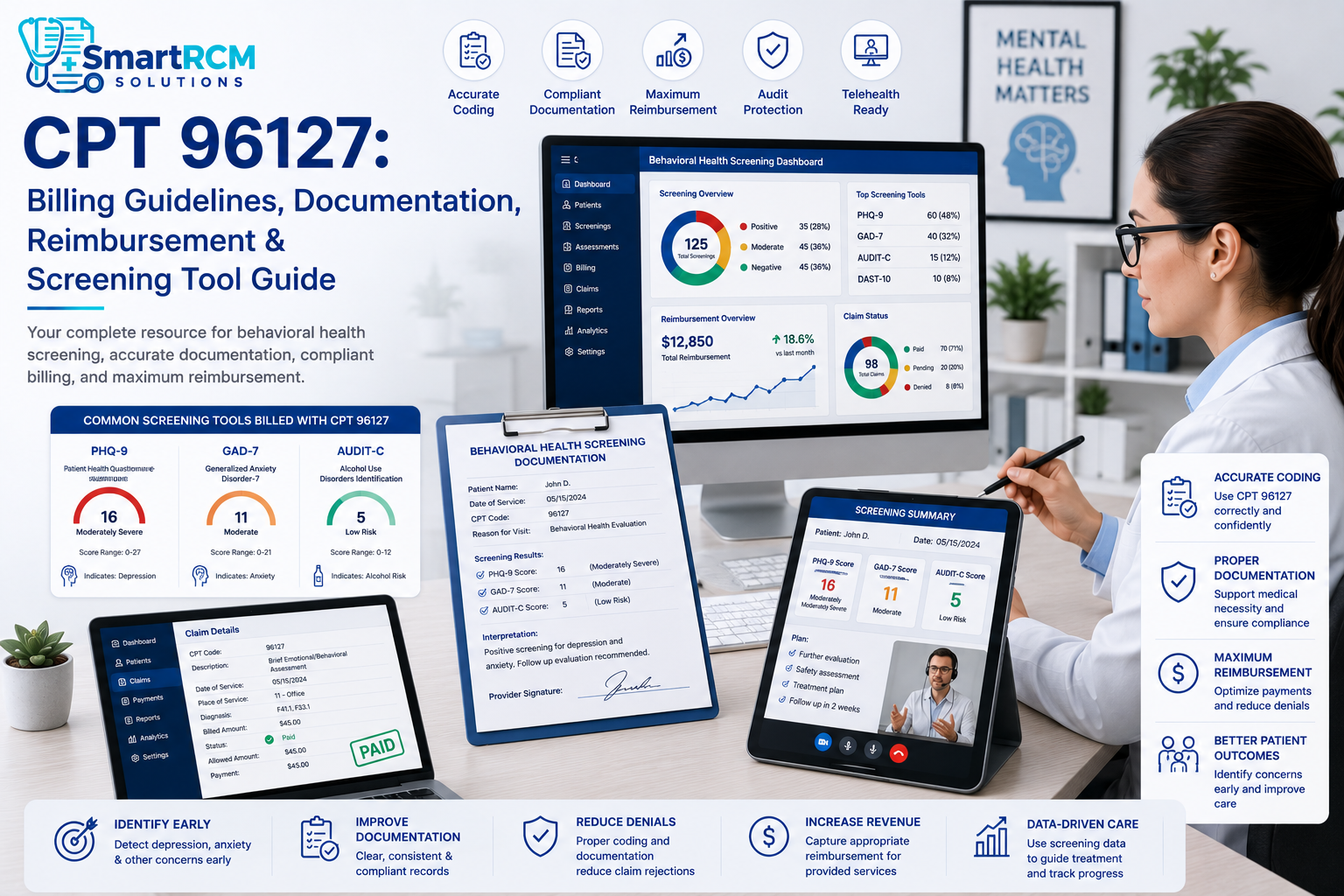
Behavioral health screening has become an essential component of modern healthcare. Providers frequently use standardized assessment tools to identify depression, anxiety, substance abuse concerns, attention disorders, and other behavioral health conditions. CPT 96127 allows healthcare professionals to report these brief emotional and behavioral assessments.
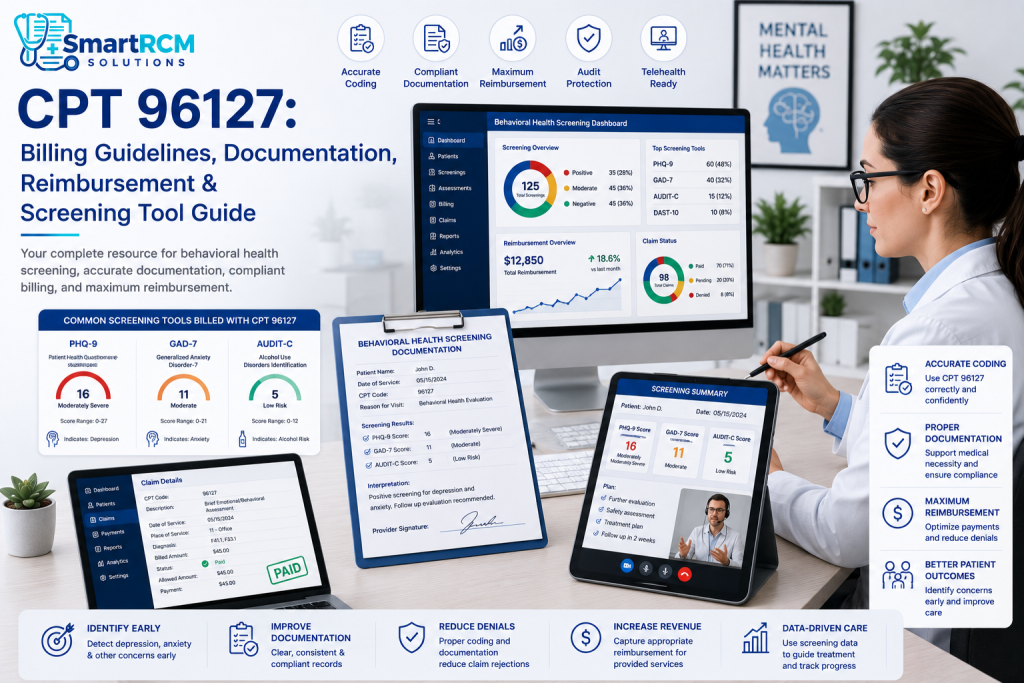
CPT 96127 – A Detailed Guide
Because screening tools are commonly used in primary care, psychiatry, behavioral health, pediatrics, and family medicine, providers must understand the billing requirements, documentation standards, reimbursement considerations, and payer-specific rules associated with CPT 96127.
Accurate reporting helps practices improve reimbursement, support quality care initiatives, and reduce claim denials.
CPT 96127 Quick Answer
CPT 96127 describes a brief emotional or behavioral assessment administered using a standardized screening instrument with scoring and documentation. Providers commonly use this code for depression screenings, anxiety assessments, ADHD evaluations, substance use screenings, and other behavioral health assessment tools.
CPT 96127 Description
Before billing this code, providers should understand its official purpose.
CPT 96127 describes a brief emotional or behavioral assessment performed using a standardized instrument, including scoring and documentation.
Unlike psychotherapy codes that report treatment services, CPT Code 96127 reports screening and assessment activities designed to identify behavioral health concerns or monitor patient progress.
Providers frequently use this code during:
- Preventive visits
- Behavioral health evaluations
- Follow-up assessments
- Treatment monitoring visits
CPT 96127 Time Requirement
One of the most common questions involves time requirements.
CPT 96127 Time Guidelines
Unlike psychotherapy services such as CPT 90832, CPT 90834, and CPT 90837, CPT 96127 is not a time-based code.
Providers report the service based on:
- Administration of a standardized assessment tool
- Scoring of results
- Documentation of findings
Therefore, billing depends on completing the assessment rather than meeting a specific time threshold.
Behavioral Assessment CPT Code 96127 at a Glance
| Category | Details |
|---|---|
| CPT Code | 96127 |
| Description | Brief Emotional or Behavioral Assessment |
| Time Requirement | Not Time Based |
| Service Type | Screening and Assessment |
| Common Specialty | Behavioral Health, Psychiatry, Primary Care |
| Documentation Required | Yes |
| Standardized Tool Required | Yes |
Common Screening Tools Used With CPT 96127
Providers often report Mental Health Assessment Code 96127 when administering validated screening instruments.
Common examples include:
PHQ-9
The Patient Health Questionnaire-9 helps identify and monitor depression symptoms.
GAD-7
The Generalized Anxiety Disorder-7 assessment evaluates anxiety severity and treatment response.
Vanderbilt Assessment Scale
Providers frequently use this tool when evaluating ADHD symptoms in children and adolescents.
AUDIT
The Alcohol Use Disorders Identification Test helps identify risky alcohol use behaviors.
DAST
The Drug Abuse Screening Test evaluates substance use concerns.
PSC-17
The Pediatric Symptom Checklist helps identify behavioral and emotional concerns in children.
Because payers may require standardized tools, providers should ensure the assessment instrument is validated and appropriately documented.
Who Can Bill CPT 96127?
Several healthcare professionals may report CPT 96127 when payer requirements are met.
Common provider types include:
- Psychiatrists
- Psychologists
- Primary Care Physicians
- Pediatricians
- Nurse Practitioners
- Physician Assistants
- Licensed Behavioral Health Providers
Provider eligibility varies by payer policy and state regulations.
Therefore, practices should verify billing requirements before claim submission.
When Should Providers Use CPT Code 96127?
Providers commonly report 96127 CPT Code when they perform behavioral health screenings or monitor treatment progress.
Common scenarios include:
- Depression screening
- Anxiety screening
- ADHD assessment
- Substance abuse screening
- Behavioral health follow-up evaluations
- Pediatric behavioral assessments
- Mental health treatment monitoring
Additionally, providers often use repeated assessments throughout treatment to track patient outcomes and clinical improvement.
CPT 96127 Documentation Requirements
Proper documentation remains critical for reimbursement and compliance.
Documentation should include:
Assessment Tool Used
Clearly identify the screening instrument administered.
Examples include:
- PHQ-9
- GAD-7
- Vanderbilt
- AUDIT
- DAST
Assessment Results
Document:
- Score obtained
- Clinical interpretation
- Severity level when applicable
Medical Necessity
Providers should explain why the assessment was performed and how the results influence patient care.
Follow-Up Plan
Documentation should support:
- Treatment recommendations
- Additional evaluations
- Referrals
- Monitoring plans
Strong documentation helps reduce denials and supports medical necessity.
CPT 96127 Reimbursement Information
Reimbursement for CPT 96127 varies based on several factors, including the payer, provider specialty, geographic location, and contract terms.
Although CPT 96127 is considered a relatively low-value code compared to psychotherapy services, it can significantly improve revenue capture when providers consistently document and report behavioral health screenings.
Many organizations overlook reimbursement opportunities associated with routine depression, anxiety, ADHD, and substance use screenings. Consequently, properly billing CPT 96127 can help practices receive payment for services already being performed.
Factors affecting reimbursement include:
- Insurance carrier
- State regulations
- Provider type
- Contracted fee schedules
- Number of assessments performed
- Medical necessity requirements
Because payer policies differ, providers should verify reimbursement guidelines before submitting claims.
Can CPT 96127 Be Billed More Than Once?
One of the most frequently searched questions involves billing multiple units of CPT 96127.
The answer is often yes.
Providers may report multiple units when administering multiple distinct screening instruments during the same encounter, provided payer guidelines allow it.
Example
A provider administers:
- PHQ-9 Depression Screening
- GAD-7 Anxiety Screening
In this scenario, some payers may allow two units of CPT 96127 because two separate validated assessment tools were completed.
Documentation Requirements
When billing multiple units:
- Document each screening tool separately
- Include individual scores
- Record clinical interpretation
- Support medical necessity
Providers should always review payer-specific rules because some plans limit the number of units reimbursed per visit.
CPT 96127 and Annual Wellness Visits
Behavioral health screenings frequently occur during preventive care visits.
As a result, CPT 96127 is commonly reported alongside:
- Annual Wellness Visits
- Preventive Medicine Services
- Pediatric Well-Child Visits
- Primary Care Evaluations
Why This Matters
Routine screening helps identify behavioral health conditions earlier.
Early identification often leads to:
- Faster intervention
- Improved treatment outcomes
- Better patient engagement
- Reduced healthcare costs
Because preventive care increasingly incorporates mental health assessments, CPT 96127 has become more valuable across multiple specialties.
Can CPT 96127 Be Billed With Psychotherapy Services?
In many situations, yes.
Providers may report CPT 96127 alongside behavioral health treatment services when documentation supports both services.
Examples include:
Example Scenario
A psychologist performs:
- PHQ-9 assessment
- 45-minute psychotherapy session
The screening assessment and psychotherapy service represent separate activities.
Therefore, both services may be reportable when documentation supports each component and payer policies permit.
Telehealth Considerations for CPT 96127
Behavioral health organizations increasingly administer screening tools through telehealth encounters.
Patients may complete assessments electronically before appointments or during virtual visits.
Before billing telehealth services, providers should verify:
✓ Telehealth eligibility
✓ Documentation requirements
✓ Modifier requirements
✓ Place of service rules
✓ Payer-specific coverage policies
Because telehealth regulations continue to evolve, verification remains essential.
Real Billing Examples
Understanding practical scenarios helps improve coding accuracy.
Depression Screening
Service Provided
A primary care provider administers a PHQ-9 assessment during a routine office visit.
Documentation
- PHQ-9 completed
- Score documented
- Clinical interpretation recorded
- Follow-up plan established
Billing
| Service | Code |
|---|---|
| Depression Screening Assessment | CPT 96127 |
Because a validated screening tool was administered and documented, CPT 96127 may be reported.
Anxiety and Depression Screening
Service Provided
A behavioral health provider administers:
- PHQ-9
- GAD-7
Billing
| Service | Units |
|---|---|
| CPT 96127 | 2 Units* |
*Subject to payer guidelines.
Documentation should support both assessments separately.
Psychotherapy Plus Assessment
Services Provided
- GAD-7 Anxiety Assessment
- 45-Minute Psychotherapy Session
Billing Example
| Service | Code |
|---|---|
| Anxiety Screening | CPT 96127 |
| Individual Psychotherapy | CPT 90834 |
When documentation supports both services, providers may report both codes according to payer requirements.
Common Billing Mistakes
Several preventable errors contribute to denials involving CPT 96127.
Missing Assessment Scores
Providers sometimes document that an assessment occurred but fail to include the score.
Without scoring information, payers may question whether the assessment meets CPT 96127 requirements.
Using Non-Validated Screening Tools
Many payers expect providers to use recognized and validated assessment instruments.
Using informal questionnaires may create reimbursement challenges.
Billing Without Medical Necessity
Documentation should explain why the screening was performed and how the results affect patient care.
Failure to establish medical necessity can result in denials.
Incorrect Unit Reporting
Billing multiple units without supporting documentation frequently triggers claim review.
Providers should document each assessment individually.
Incomplete Documentation
Documentation should include:
- Screening tool used
- Score obtained
- Interpretation
- Clinical significance
- Follow-up plan
Comprehensive records strengthen reimbursement support.
Denial Prevention Strategies
Strong workflows help organizations maximize reimbursement while reducing billing errors.
Standardize Screening Processes
Create consistent procedures for:
- Assessment administration
- Scoring
- Documentation
- Follow-up planning
Standardization improves compliance and reporting accuracy.
Train Clinical Staff
Providers should understand:
- Approved screening tools
- Documentation requirements
- Unit billing rules
- Payer-specific policies
Ongoing education improves claim accuracy.
Audit Claims Regularly
Routine audits help identify:
- Missing documentation
- Incorrect units
- Coding errors
- Compliance risks
Consequently, practices can address issues before they become recurring problems.
Verify Payer Requirements
Before claim submission:
✓ Confirm coverage
✓ Verify unit limitations
✓ Review documentation requirements
✓ Check reimbursement policies
Because payer expectations vary significantly, verification remains one of the most effective denial prevention strategies.
al authority and improve user navigation throughout your behavioral health content cluster.
Frequently Asked Questions
Q. What is CPT 96127?
A. CPT 96127 is a behavioral health assessment code used to report a brief emotional or behavioral screening performed with a standardized instrument, including scoring and documentation.
Q. What is the official CPT 96127 description?
A. The official CPT 96127 description is: Brief emotional or behavioral assessment, with scoring and documentation, per standardized instrument. Providers use this code to report validated behavioral health screening tools and outcome assessments.
Q. Is CPT 96127 a time-based code?
A. No. CPT 96127 is not a time-based code. Unlike CPT 90832, CPT 90834, and CPT 90837, providers bill CPT 96127 based on the administration, scoring, and documentation of a standardized assessment rather than the amount of time spent.
Q. Which screening tools can be billed with CPT 96127?
A. Common standardized screening instruments include: PHQ-9. GAD-7, Vanderbilt Assessment Scale, DAST, AUDIT, PSC-17, Other validated behavioral health screening tools. Providers should verify payer requirements regarding approved assessment instruments.
Q. Can CPT 96127 be billed more than once on the same day?
A. Yes. Many payers allow multiple units of CPT 96127 when providers administer multiple distinct screening tools during the same encounter. However, documentation must support each assessment separately, and payer-specific limitations may apply.
Q. Can CPT 96127 be billed with psychotherapy services?
A. In many cases, yes. Providers may report CPT 96127 alongside psychotherapy services such as: CPT 90832, CPT 90834, and CPT 90837. Documentation should clearly support both the assessment and psychotherapy service.
Q. Can CPT 96127 be billed with CPT 90791 or CPT 90792?
A. Some payers allow CPT 96127 to be reported alongside psychiatric diagnostic evaluations when separate behavioral health assessments are administered and documented. Providers should always verify payer-specific billing guidelines.
Q. Does CPT 96127 require a modifier?
A. Modifier requirements vary by payer. Some payers may require modifiers when CPT 96127 is reported with other behavioral health services. Providers should verify coding guidance before claim submission.
Q. Why are CPT 96127 claims denied?
A. Common denial reasons include: Missing assessment scores, Incomplete documentation, Billing unsupported units, Lack of medical necessity, Use of non-validated screening tool, and Payer-specific coverage limitations. Accurate documentation helps reduce these denials.
Q. Who can bill CPT Code 96127?
A. Qualified healthcare professionals may report CPT 96127, including: Psychiatrists, Psychologists, Primary Care Physicians, Pediatricians, Nurse Practitioners, Physician Assistants, and Behavioral Health Providers. Eligibility depends on payer policies and credentialing requirements.
Conclusion
CPT 96127 is an important behavioral health assessment code that allows providers to report standardized emotional and behavioral screenings. Because early identification of mental health conditions improves treatment outcomes, routine use of validated screening tools has become increasingly common across psychiatry, behavioral health, primary care, and pediatric practices.
Furthermore, understanding CPT 96127 billing requirements helps organizations improve reimbursement accuracy while supporting quality patient care. Providers should ensure that every assessment includes a validated screening tool, documented scores, clinical interpretation, medical necessity, and an appropriate follow-up plan.
Accurate reporting becomes even more important when billing multiple assessment units or combining CPT 96127 with psychotherapy and psychiatric evaluation services. Therefore, organizations should maintain strong documentation standards, verify payer requirements, and conduct regular coding audits to reduce denials.
As behavioral health screening continues to expand, CPT 96127 will remain a valuable code for monitoring patient outcomes, supporting treatment decisions, and strengthening revenue cycle performance.
Additionally, CPT 96127 should be integrated into a broader behavioral health content strategy that includes Mental Health CPT Codes, Psychiatry CPT Codes, CPT 90791, CPT 90792, CPT 90832, CPT 90834, CPT 90837, Mental Health Modifiers, and Modifier 95. Together, these resources create a comprehensive mental health billing knowledge base that improves topical authority and SEO performance.